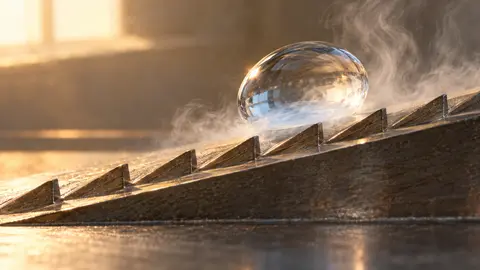
A light pulse passes through a bottle, reaches its cork and leaves towards the bottom. In 2011, MIT researchers show this journey in a slow motion video. The light seems to be moving slowly enough so that our gaze can follow its movement.
The device collects data with a temporal resolution corresponding to a trillion exposures per second. But a difficulty remains hidden behind the result: the camera only records a thin slice of the scene. It does not directly produce a full video.
The researchers repeat the same experiment by gradually repositioning the camera. The laser and the measurements are synchronized, then algorithms assemble the data into successive images. About an hour of collection was needed to reconstruct this extremely brief passage.
This process therefore does not allow any unpredictable event to be filmed freely. The scene must be reproducible. The spectacular result comes as much from calculation as from optics: an invisible displacement on our scale finally becomes observable.
What we know
Reconstructed video, not continuous recording of an unpredictable event.
To go to the source
References accessed October 11, 2026. Linked pages may be in another language.
Signaler une erreur ou apporter une précision