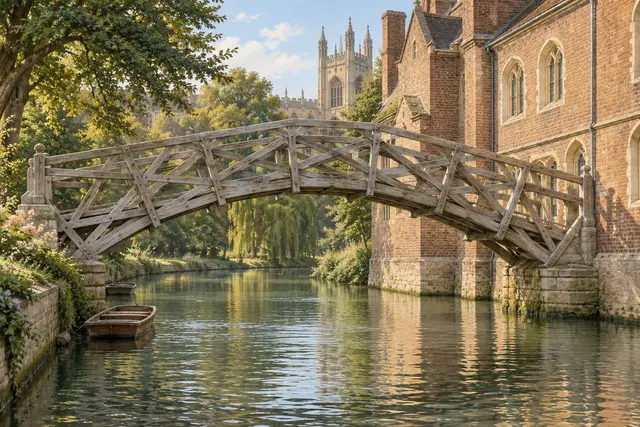
At Queens’ College, a wooden bridge crosses the Cam by drawing an arch. Looking at his frame, however, we discover straight pieces that cross. Their arrangement and their assemblies allow to build a curved shape without having a huge curved beam.
William Etheridge prepared the drawing in 1748, then James Essex built it in 1749. The work was repaired and rebuilt, especially in 1905, according to the same principle. The college archives explain how the elements work mainly in compression, with triangles that stiffen the whole.
A legend associates this Mathematical Bridge with Newton and a construction without bindings. The documents of the college deny these two shortcuts: the scientist had died before its construction, and the assemblies had many attachments. The real surprise does not need the legend. Straight woods, properly assembled, produce an arch singular enough for visitors to invent a famous author.
What we know
Documented principles and constructors; current bridge rebuilt, attribution to Newton and lack of disproven fixations.
To go to the source
References consulted on 3 October 2026. Linked pages may be in another language.
Signaler une erreur ou apporter une précision