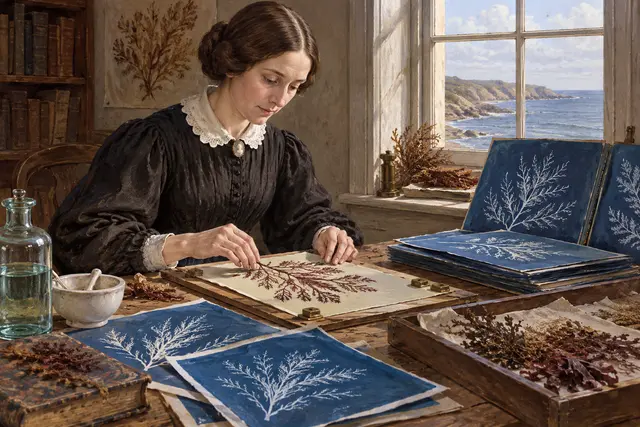
On a deep blue background, algae appear in pale silhouettes. These are not drawings that their author would have patiently copied. In 1843, Anna Atkins began to publish a botanical work whose images are produced by light: cyanotypes. The specimen is directly involved in the making of his portrait.
The seaweed is placed on paper made sensitive to light. The parts it protects do not react like the exposed areas. After washing, its shape stands out on the blue. This process, developed by John Herschel, allows to preserve details useful to distinguish species, while creating remarkable compositions.
Atkins produced the prints of his book, published in small numbers. The book becomes a milestone in photographic publishing. Behind its apparent simplicity meet collection, identification, chemistry and layout: to bring these algae into a book, it was first necessary to learn to let their shadow work.
What we know
Atkins applied the cyanotype to botany; she did not invent the process.
To go to the source
References consulted on September 21, 2026. Linked pages may be in another language.
Signaler une erreur ou apporter une précision