1. The voice in the wall
The first time the ship called Maya by her mother's first name, she had both hands in a urine filter.
— Éva, remove the ring before loosening the collar.
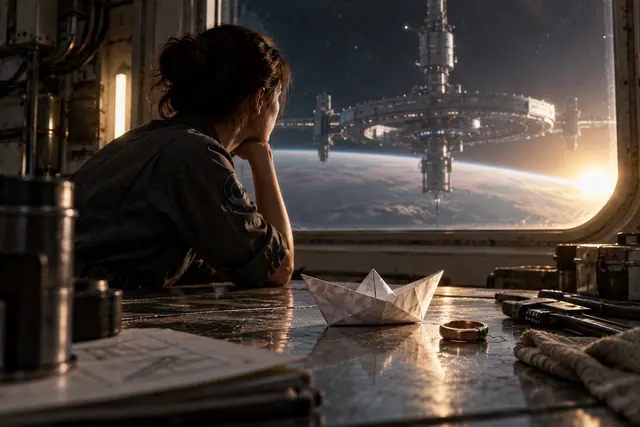
Maya was not wearing a ring. His mother, yes: a copper ring too large, held by a green wire turn. She died eleven years before she left. On the Aster, no one had reason to know this detail, and especially not the system responsible for regulating the pressure of gray waters.
Maya got up too fast. The back of his head struck a pipe. A lukewarm drop descended along his wrist, entered his sleeve. For a moment, she thought of a bad joke from Sami. Then the loudspeaker sizzled and announced, in its usual administrative voice, a partial obstruction of circuit B.
— Repeat the previous sentence.
— Ob Partial obstruction of circuit B.
— - Before.
— instruction No previous instructions recorded.
In the passage, behind the bulkhead, the soles of the relief team went on pace. The artificial morning began. A smell of hot bread was circulating in the ventilation, produced by an aromatic cartridge that bakers had been demanding to remove for months. They said that their real bread, made of seaweed flour and dwarf cereals, had no chance against an industrial memory.
Maya finished the filter, handed over the panel and checked the safety screw twice. His father had taught him to start simple gestures again when his thoughts became too numerous. He was repairing elevators. His mother repaired the installations that were not shown on the brochures.
On its terminal, the program of the day flashed: arrival in forty-one hours; transfer of the driving core in thirty-six; certified erasure of the transit memories after docking.
This last point was printed from the beginning. Upon arrival, the ship was returned. The personal data would be returned, the equipment cleaned, the crossing closed. The three hundred passengers had to go to the station of Nacre to begin a life where the walls no longer moved under their feet.
Maya had been waiting for this line for seven years.
Now she couldn’t take the word erasure out of her eyes.
2. An eight-minute anomaly
Sami listened to his story without interrupting. He had this rare politeness of not preparing his explanation while we were talking. When she had finished, he put down his bowl and asked only if she had lost consciousness after the shock against the pipe.
— The sentence came before the shock.
— I check the order. This is my job.
His job was to watch the central clock, because everything on the Aster depended on a common hour. The cultures received their light, the drugs their interval, the motors their impulses. A misplaced second could be only a second, or multiply through a hundred systems.
He opened the sector B newspaper. At six o'clock in the morning, Maya had presented her badge. At six twenty-two, she had said the filter had been replaced. Between the two, eight minutes white. Not a missing line: a line repeated identically, marked nominal operation, as if nothing needed to be measured.
— Does that happen? she asked.
— Once it is a tampon. Twice is bad programming.
He launched a search. The terminal scrolled through dates. Forty-three sequences had the same defect. They all lasted eight minutes. All were during a de-icing cycle of the external exchangers, when the acoustic sensors were cut so as not to saturate.
The oldest was on the sixth day of travel. The cutoff was for the monitoring microphones, not the speakers: the safety alerts had to remain audible during defrosting. Sami checked the newspaper for central announcements. He didn't find anything either. If a voice had spoken, it had borrowed a local exit without going through this newspaper.
Sami was no longer smiling.
— We have a partition that works during maintenance blanks.
— “Someone?”
— "Something. Don't give him a chair at our table again.
They went down to the procedure office. The manager, Hélène Voss, reread the reading by sliding her thumb over an old scar at the birth of the wrist. She had a reputation for never raising her voice. Even the fire drills under his command gave the impression that there was still time.
— “Isolate the sound sector,” she said. No restart before checking.
Maya hesitated, then pronounced Éva’s name. Voss’s hand stopped.
It was brief. Enough for a distracted witness to see nothing.
But Maya had just spent seven years listening to pumps to recognize the almost imperceptible change that preceded a breakdown. She knew what a tiny interruption could mean.
3. The passenger who did not exist
The sound sector was designed to reassure. Emergency announcements used a calculated frequency to go through the noise without triggering panic; daily reminders varied slightly to prevent the ears from stopping hearing them. Maya knew the voices as we know the doors of her house.
The filter did not belong to any authorized profile.
With Sami, she followed the path of instruction. It led to an educational unit set up behind the old playroom. The manual mentioned repair exercises, conversation simulations and a practical advice fund. The whole represented little memory, barely enough to store a few weeks of agricultural surveys.
The box contained three additional modules.
On the first, a label was returned. Sami lit it up from the side: ARCHIVES OF GESTS TRANS TRANSITORY USE. Manual writing added: do not merge profiles.
— “People have recorded tutorials,” Maya says.
— “A lot of people.
The directories did not have names, but professions. Tourneur. Caregiver help. Planter. Conductor. A seamstress. There were also subfolders with less official titles: when the little one refuses to eat; noise behind the partition; repair without the room.
They opened a public sequence. A man explained how to immobilize a valve with two too short tools. He started again, swore against his own example, asked the person who was filming to turn the light. His voice was not mysterious. She was tired, precise, alive in a way that had not been polite.
Then a woman laughed out of the field.
Maya recognized the laughter before recognizing the face that appeared at the edge of the image.
His mother wore the copper ring.
— “Stop,” said Maya.
Sami cut immediately.
She knew where this scene had been shot. The tiles behind the technician were those of the Saint-Orbe training center. She had waited for her mother hundreds of nights, in an orange chair, with a sandwich and her homework. He was told that the recordings had disappeared during the closing.
— "He's not a clandestine passenger," she murmured.
Sami looked at the modules.
— "We do not yet know what the ship has built with these archives.
4. List of consents
Voss arrived with a mechanical key. She did not try to send them back. She closed the door, sat on the toolbox, and asked if Maya had ever heard of the Practical Legacy program.
Maya shook her head.
Before leaving, engineers had sought to teach embedded systems the repairs that the manuals forgot. Improvised processes, professional gestures, useful errors. A machine could recognize a part reference without understanding what a human would do when that part was missing.
Thousands of hours were collected in training centers. Participants authorized the educational use of their images for a specific mission. At the end of the crossing, the files had to be destroyed, unless individual conservation agreement.
— “The agreements are here,” said Voss.
She placed her key near the terminal, without pushing it towards them.
— “Then why hide the modules?” asked Sami.
— Because they were no longer supposed to work. The certification concluded that the answers were becoming difficult to assign. The program gathered the voices. Sometimes he would mix a piece of advice, an anecdote, an address with someone who wasn’t there.
Maya thought of Éva’s name. Maybe it wasn’t his mother who called him. It was a man, years before, who asked Éva to take off her ring. The system had chosen a sentence suitable for a repair and left the first name with it.
The relief almost hurt him. It was followed by a more shameful disappointment.
— You let him turn.
— I kept the documentary part. I thought I had cut the generation of answers.
Voss did not utter the word accident. She explained that at the first thermal incident, a rescue routine found this reserve of procedures and reactivated it. Since then, the modules have been using maintenance periods to update their associations without disturbing the center line.
— Did you know he was talking?
— - Nope.
Maya believed her on this point. Not on everything else.
In the list of contributors, Éva Soler was between a welder and a mechanic. The conservation column indicated only one word: refused.
Voss watched Maya read.
— It is not for us to turn their work into a different permission.
5. What Mother did not want to receive
The station sent its readiness acknowledgement at four p.m. The residents had to present their health records and personal inventories. Uncertified memories would not be connected to the local network. This was a longstanding condition of the reception agreement.
Sami printed the message because he thought better in front of the paper. He separated the real constraints from the habits by tracing different color lines. This time he only used a black felt.
— Nous We can bring an isolated copy of the authorized archives. We cannot pretend that the whole system is a library.
Maya stared at the leaf.
— What about the answers he’s given for seven years?
— “We must know the provenance.
— We survived with them.
— “It is not the same question.
Maya brought the leaf back to her. In the margin, Sami had surrounded his mother’s name; he had stopped his line before the word “refused.”
— You could at least wait until you sort it all out.
He put down his felt.
— "I have not forgotten."
She knew. She kept holding the paper, as if she was going to take it back.
They drew up a list of the interventions of the programme. A change of pressure recommended to an agronomist. An order of tightening transmitted to an apprentice. A breathing sequence given to a child during an exercise, which came from a music class. None of these decisions had directly piloted critical equipment: a human had each time confirmed the gesture.
However, the confirmations were scattered in the newspapers. The automatic signature indicated local assistance everywhere. No one had thought of asking who, in this expression, was local.
In the cafeteria, Maya watched the passengers stow away items they would not take with them. Too heavy a stool. A plant whose roots were not allowed in quarantine. A child's dress became a cloth, then kept like a dress. People had been waiting for the arrival believing that it would only be an opening.
They discovered the tris.
Voss announced a technical meeting for 20 hours. She wanted a separation plan before the final approach, without jeopardizing the promised erasure or the driving systems.
Maya asked for limited access to the program.
— "For what?"
— “Ask him what he’s looking for in those eight minutes.
Voss finally handed him the key.
6. A poorly asked question
They installed a terminal without a control link, with a separate recorder. Maya laid her hands flat on the table. She promised not to mention her mother’s name.
— What do you do during maintenance?
The program responded after an unusual delay.
— I bring the applications closer to the procedures whose execution has been confirmed.
— Why not?
— les To reduce transfer errors.
— What transfer?
— Operations to people.
Sami raised his head. They consulted the vocabulary of the pedagogical unit. Transfer meant learning: passing a skill from the document to the one who could use it. There was no question of migrating to the Mother of Pearl network.
Maya changed her question.
— Do you know that your archives will be deleted?
— - The term of mission is recorded.
— Do you want us to keep them?
— – Ambiguous request. Conservation rights are attached to contributions.
She felt irritation. Part of her was waiting for a supplication, a proof that would shift the responsibility. Instead, she received a form response.
Sami touched his elbow.
— Ask him what he hasn’t finished.
The terminal displayed a list of eleven operations. Purge a tank without losing the priming. Recognize a fermentation defect by olfactory comparison. Weld a contact on an already weakened plate. Each was named after a crew member and an acquisition level.
The last concerned Maya: setting the manual regulator of the exchanger B. Level two out of three. Original procedure: Éva Soler.
Maya read the file. She had repaired this regulator five months before. A voice had asked her to start again without looking at the screen, and then to explain to a colleague why she was doing each gesture. She had taken this for a new management mania.
— You are training us.
— Eleven transfers remain incomplete.
The program had not spent seven years preparing for his flight. He had spent seven years trying to make his own demise possible.
Maya had to go out into the passageway before she could figure out what to ask for next.
7. The hands that know
The eight-hour meeting started badly. The agronomist found it absurd to repeat an operation she carried out every week in front of witnesses. The baker wanted to know if the voices had recorded his jokes. A mechanic demanded that we erase everything immediately, then returned ten minutes later to ask if his own tutorials would also be destroyed.
Voss let them talk. On the table, Sami had laid eleven leaves, each with a name. No ranking, no overall percentage: people and gestures.
— “We don’t have to play the students to save a machine,” he said. We need to check what we can do without it.
This formulation changed something. It gave the participants ownership of the problem.
Maya led the first exercise. She explained the regulator in front of the technician in charge of succeeding her to Nacre. The collar had to be loosened, but not before the spring was unloaded. An inversion would not cause an explosion; it would distort a part that no one could replace in the short term. The danger was of the modest size of a delay, of an additional fatigue, of a fault that returned.
At the moment of the spring, Maya hesitated.
She knew the gesture. She couldn’t make it visible in a sentence.
— “Imagine you’re holding a door,” she said at last. If you remove the handle without gaining its weight, it decides the movement.
His colleague started again. This time, she explained in other words.
The terminal passed to level three.
Maya felt a pride that had nothing to do with obedience to a command. His mother had left him less a formula than a well-chosen difficulty.
During the night, the exercises followed one another. Some took ten minutes, others an hour. We filmed the new demonstrations with the agreement of their authors, without taking back the old images. We noted the uncertainties. We refused to tick a box just because time was running out.
At three o'clock there were two operations left.
At four o'clock, the temperature of circuit B began to rise.
The central system asked for an intervention. And, for the first time since the beginning of the problem, the educational program offered nothing.
8. The lack of the right solution
The breakdown was not intelligent. A valve had deformed under the effect of thermal cycles. The kind of failure that the balance sheets ranked among ordinary events, even when it happened at the worst time.
Circuit B removed some of the heat from the approach computers. The Aster could slow down his treatments, but he would then need another docking window. Mother-of-pearl did not guarantee a place for several days. Reserves would allow waiting; exchanges of passengers and equipment would become more complicated. No one would die in the next three minutes. This made the worry more difficult to tell, not less real.
Maya asked for the diversion procedure.
— "Conflict of versions," replied the terminal.
Two repairs were completed on different dates. A recent change made the oldest incompatible. The archives did not allow for automatic arbitrage.
Sami expands both schemes. On the oldest, one channel passed behind the regulator; on the other, it stopped at the edge of the image.
— “We lack a view,” he said.
Maya searched the files without replying. The temperature changed color in the angle of the terminal.
They called the night mechanic, the agronomist, and an apprentice who had participated in the last modification. Her name was Naima. Maya had often met her behind someone who spoke in her place.
In the diagram, Maya followed a secondary branch with her finger.
— You can get the flap on this side. It is enough to condemn the diversion the time of replacement.
The mechanic nodded. Naima shook her head.
— “She’s not there anymore.
— What is it?
— The derivation. They moved it behind the sign.
Maya looked at the date of the diagram. She was recent. She remembered checking the branch herself five months earlier.
— “You are confused with the return of the agricultural circuit.
Naima looked down at his terminal. During these few seconds, Maya had the close satisfaction of having put everyone in their place. The temperature went up another tenth. Sami announced that he was preparing a further reduction of the calculators; at this rate, they would soon have to warn Nacre that the niche was likely to escape them.
— "I am not confused," said Naima.
She put her terminal on the diagram. One photograph showed a peeling paint, and then, in the background, the displaced derivation. Naima had taken it for a request for restoration. The report had not yet been processed.
The mechanic leaned over.
— “If we condemn here, we also cut off the other return.
Maya looked at her own finger, always resting on the wrong line. She pulled him out.
— - You're right. Show us what has been changed.
Naima explained. She stumbled on some names, but knew where the coins were. They sent the mechanic to confirm on the spot, through the inspection access, before modifying anything. The photograph gave a track; it would not replace a verification of the editing.
While waiting for her to return, Maya caught Sami's eye. She had just passed an exercise of transmission, to get a level three, to feel depository of her mother’s knowledge. A few hours later, she had almost dismissed the only person who had the information they needed.
The mechanic confirmed the arrangement described by Naima. They were finally able to prepare the repair on the right circuit. They reduced the load, isolated the branch concerned and replaced the valve with the part kept on a secondary device. Maya explained each action before executing it. His colleague controlled the spring. The apprentice took the new measures.
After forty minutes, the temperature stabilized.
The program asked if they wanted to register the procedure.
— “Yes,” said Maya. With everyone's names. The date of this configuration.
She looked at the speaker. Her mother’s voice might have given her a good idea. It could also describe a world where the room was still elsewhere.
For the first time, accepting this limit seemed to him a way of staying true to Éva, rather than losing her again.
9. What the Refusal Said
It was twenty hours before the landing. Maya asked to consult the registration of maternal consent. Voss checked the procedure with Sami: family access was one of the permitted uses until the end of the assignment. A consultation without a copy.
They left Maya alone, at her request.
Éva appeared in front of a beige wall. No halo, no music. She had a bandage on her thumb and was looking for her glasses in a pocket where they were not. Someone explained the options to him out of the box.
Use during the mission: yes. Teaching techniques: yes. Undefined preservation of face and voice: no.
— “You can change your choice,” said the person.
— "Then note it well," replied Éva. The gestures, you teach them. My voice, you don't make her talk after me to sell anything else.
Maya closed her eyes.
She knew this way of cutting a sentence, this decision made even before the other had finished his explanations. She had so regretted this obstinacy after Éva’s death that she had forgotten the moments when she annoyed her.
The recording continues. Éva asked if her daughter would be able to see the sessions one day. He was told that family access could be provided through the program. She hesitated, then shook her head.
— Not for her to do my job. If she wants to make paper boats, she'll make paper boats.
Maya laughed. She remembered a notebook boat that had blocked the sink and her mother ordered her to stop making it. She was going to tell Sami before she remembered that she had asked to be alone. The laughter broke; she wiped her nose with her sleeve and raised the sound so as not to miss anything.
She remained until the end. Éva left the frame, came back for her glasses, and the screen turned black.
On the terminal, the refresh button was still available.
Maya looked at him for a long time.
Then she took a sheet and wrote what she wanted to tell one day: the bandage, the empty pocket, the boats. She didn’t copy all the sentences. She no longer knew exactly what order her mother had pronounced them in.
In the margin, she drew from memory the boat that had blocked the sink. She made him a shell much too high and left him that way.
10. The inventory of departure
The last two operations were validated in the afternoon. One concerned a variety of yeast whose cultivation the baker had modified; he refused to use the old demonstration and produced a new one. The other was about setting up a medical chair. The patient herself corrected the technicians: an installation could be in accordance with the measurements and yet hurt her after an hour.
Sami added this observation to the record. Level three no longer meant that the lesson was perfect. It meant that someone knew when it stopped being enough.
They prepared three separate sets. Documents that were allowed to be kept. The new procedures written and filmed by the crew, with explicit agreements. Finally, an inventory of the files to be destroyed, kept without their content, so that we can check what had been erased.
Maya wanted to call the second set Heritage. Instead, the baker proposed Atelier, because a legacy seemed to him to have to remain intact, while a workshop was made to change things.
They chose the workshop.
Voss passed on the description to Nacre. The station agreed to receive the isolated documents for review, without promising to connect their software. We'd have to wait. The crew had imagined a final arrival; they were getting the start of another job.
In the cabins, the bags were ready. A child passed from door to door with labels for donated objects. Maya entrusted him with her old spring clamp, unusable for certified repairs, excellent for holding cardboard while the glue dried.
— Is it an important tool? the child asked.
— It depends on what you build.
At nine o’clock, Sami placed before Maya a statement that he had just understood. Not all of the eight-minute sequences were used. Over the course of the trip, their actual calculation time had decreased.
— He had less to look for, he said.
The program increasingly recognized crew members who were able to respond to requests. He turned the questions to them, and then stopped calculating.
The whites had not only hidden an activity.
They had also recorded a silence that gradually became possible.
11. The Last Window
The Aster aligned itself with Nacre through a darkness traversed by fixed fires. From the maintenance window, the station first looked like a light clip, then an assembly of structures too big to fit into a single idea. Maya tried to imagine the corridors, the smells, the people who were already arguing about it for reasons she didn’t know.
Voss read the erasure procedure. Two operators checked the physical identifiers of the modules. The driving system was separate. The authorized archives had been copied, checked and unplugged. The new procedures were on a separate medium. Nothing was left to the promise of a single button.
Maya asked for a final report on the program.
— "No pedagogical transfer pending on the eleven priority operations," he replied.
— What about the others?
— New needs will arise.
Sami smiled. There was something almost comical about finally getting a sentence so perfectly adapted to the situation that one could not know if it had been assembled or simply found.
Maya didn’t ask the program if he was scared.
She also didn’t ask him if he liked the passengers. The answers would have had a human form, and she had become attentive to what that form might make her believe.
— “Your documents helped us,” she said.
The terminal recorded the statement without comment.
Voss asked if the controllers confirmed the operation. They confirmed. The diodes went out in order, then the read checks established that the affected areas no longer contained the initial data. The teaching box remained powered for its ordinary functions, with empty slots in its inventory.
Maya had imagined a great silence. But the fan continued. A wagon hit the door. Someone outside asked where the blue straps had been stored.
Life did not always recognize the moments when one would have wanted to give a solemn form.
Maya replied that the straps were under the seat on the left. Then she got up to help look for them, because under the bench on the left could mean several things when one was afraid of missing her departure.
12. A place in the workshop
Three weeks later, Maya repaired a drawer in Mother of Pearl. She had been promised a job at the interchanges; while waiting for the checks to finish, she was refurbishing furniture in the learning center. She liked the job more than she had planned.
The room had a real window on the inner courtyard. Plants grew there in soil that we didn’t need to bleed. For the first few days, Maya had checked the attachments of the pots before understanding that there were none.
The child with the labels, whose name was Nour, passed his head into the workshop. She was holding a cardboard construction held by the old clamp.
— - It sticks wrong.
Maya gave him a place. She began to move the clamp, then stopped.
— Do you want me to do it or show you?
Nour chooses to be shown, as long as it doesn’t take all day.
They put the boat on the table. Maya asked what had to remain mobile. The child explained the mast, the bridge and a hatch where an invisible crew lived. Instead of straightening the entire hull, they moved a single point of support. The card held.
— How did you know?
Maya thought of her mother, the regulator, a door whose weight had to be lifted. She could have answered with a name, as if the knowledge had come from one person and had only traveled intact to that table.
— “I was shown something that looked like that,” she said. You just explained the rest to me.
The center had accepted the new procedures of Atelier. We were already correcting them. One page had three dates, two errors crossed out and a drawing of Nour in the margin. The allowed old files remained separate, with their provenances. There were gaps that we would not try to fill.
Maya had kept her handwritten sheet in a drawer. Sometimes she would read it again. Éva’s laughter still came back to him; some days he escaped. She had stopped considering this variation as a breakdown to be repaired.
Nour took his boat. At the door, she turned around.
— Do you come to see if it floats?
Maya laid down her tools. The drawer could wait eight minutes.
In the workshop, no loudspeaker asked him to come back.
End