1. The Returned Letter
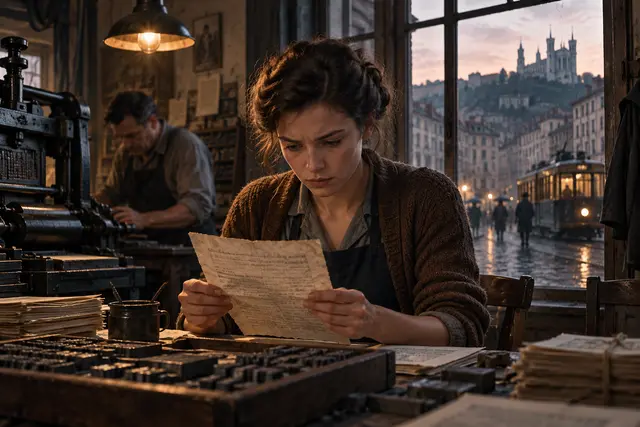
The first thing Léonie noticed was an e in reverse. The second was his brother’s name. He was in the middle of the page, between an address she knew and a date that hadn’t arrived yet.
She took her hand out of the sheet as if the ink could burn it. In the studio, Theodore did not look up. He cleaned a roll with the quiet application he reserved for dangerous work. Above them, the floor creaked: his wife passed through the kitchen. Outside, a tram braked for a long time. Lyon continued its Wednesday of April 1943, indifferent to this small line of characters.
“Did you find a shell?” he asked.
Léonie had come to correct the program of a concert. This was what the order on the workbench said, which she would have replied to someone entering through the shop. For the past four months, some orders have included other sheets, slipped under the first. She had learned to read these without asking any questions about their destination. This time, she had a specific question, impossible to keep.
“Why is Lucien here?”
Theodore wiped his fingers, took the page and finally looked at it. The names were gathered under a handwritten title: People to warn before Friday. There was no signature or explanation. The paper had been folded long enough for the ink to shift slightly to the opposite half. Lucien Morel, twenty-two, was in seventh place. Someone had added to the pencil: don’t come home until seven o’clock.
“This list should not be printed. She accompanied the text. I wanted to hand it over tonight to the person who is passing by.”
He pointed to a second leaf. She announced an upcoming police operation in several buildings and asked the residents concerned to leave their homes. The addresses were numerous, the affirmations categorical. Léonie read three times the passage where her brother’s street was. On the third pass, she noticed that her hands were shaking.
“Who wrote this?”
Theodore hesitated. She had known him since the age of fifteen. He had taught her that a space had a thickness, that a line had to hold, that a broken character betrayed an impression as a voice betrayed a man. He had never taught her what to do when a printed sentence seemed to know the future of your family.
“Someone who has already provided us with accurate information.”
In the kitchen, his wife’s step stopped. Three knocks knocked on the door leading to the courtyard. Theodore immediately folded the two leaves. Léonie had just time to see, under the fold, another name. This one was familiar to him too. It was the name of the woman who struck.
2. A visitor without a coat
Madeleine went in without her coat, despite the cold. She held a shoebox against her and seemed upset at having to stop. She would usually ask for wrapping paper, exchange two sentences about the rain and leave. Léonie had known for a long time that no one crossed the city to buy three gray leaves.
“The station is guarded,” says Madeleine.
Theodore beckoned him to lower his voice. She put the box on the table. Inside, carefully wrapped, there were print characters of a size that the workshop lacked. Léonie recognized a series of small capitals. Their arrival would have seemed wonderful an hour earlier. She felt anger at these objects, at their reasonable weight in the midst of things that had become elusive.
“Your name is on a list,” she said.
Madeleine did not ask what list. She asked where she was. It was a silence of a second, but Léonie saw him, and Madeleine saw that she saw him. Theodore took out the leaves. The visitor read standing, one hand resting on the edge of the table. In the end, she closed her eyes.
“We have to warn these people. Do not distribute the text. Not yet.”
“We are asked for three hundred copies for tomorrow,” Theodore replied.
“I know.”
Léonie waited for an explanation that did not come. The workshop suddenly seemed to be full of doors that she did not have access to. Everyone knew a fragment of the situation and pretended to protect others by keeping it. However, it was her brother who would end his day at a bicycle repairman before returning at 19:00, exactly as a person unknown said.
She decided to go looking for him. Theodore wanted her to wait for the closing. Madeleine resisted with a gesture. For the first time, the two adults did not try to give him the same order.
“Go ahead. Tell him to spend the night somewhere else. You don’t have to explain the whole thing to him.”
Léonie put on her coat, then returned to the press. The returned e was not on the handwritten list: it was in a small mention already printed, at the bottom of the reused paper. This paper came from an old delivery form. She knew this because she herself had written these forms the previous fall for the Jacquet warehouse.
She took this knowledge without announcing it. It was just a business detail. But she had just understood that the details of the trade were the only part of this case that she could answer without asking anyone's permission.
3. The brother who was waiting
Lucien worked behind the shop, leaning over a veiled wheel. He raised his head, saw his sister’s face and put down his key. She had prepared a simple sentence for the whole trip. In front of him, she said something else.
“Who knows your schedule?”
He looked at the door before answering. This look immediately confirmed the worst of his fears, without teaching him which of the worst scenarios was the right one. She would have liked him to be surprised, to joke, to reproach her for having crossed the city for an absurd question. He only wiped his hands on his apron.
“A lot of people. Why not?”
She talked about the list. No text to distribute, no characters or form, only its name and the time entered. Lucien asked if any other addresses were on the sheet. When she quoted that of Madeleine, it pales. He did not know her, he said. Then he asked if this woman lived alone.
Léonie took a step back. He had always been a bad liar. As a child, he denounced himself even before he was accused, by a sudden solicitude for the object he had just broken. The same concern now appeared to an unknown woman.
“You’ll tell me what you know.”
A customer came in to pick up his bicycle. Lucien immediately found the precise gestures of the mechanic: check the brake, explain the change of cable, return a coin. Léonie attended this scene with a feeling of unreality. Could his brother be threatened and talk about a mudguard at the same time? She discovered that fear did not interrupt ordinary occupations. She settled there.
When the client had left, Lucien closed the back door.
“I wore two envelopes for one person. I don’t know what they contained.”
“Does this person know Madeleine?”
He hesitated enough for her to understand. Then he told her the truth, or a part that she was able to recognize as such. Her name was Blanche Jacquet. She kept her uncle’s warehouse records. His father had been arrested several weeks earlier. Lucien had seen her since the winter and had not told his sister, because everything he said to his sister ended up becoming an additional worry.
This last sentence hurt her more than she expected. She turned away to give him time to regret it.
“I don’t want to decide for you,” she finally replied. But someone has already done it. Your name is on the paper.”
She asked him to sleep with their aunt, not to go to her to take a shirt. This time, he agreed. Before leaving, he drew from a drawer an envelope for Blanche. Léonie saw that it was not closed. Inside there was a photograph of him, badly framed, where he smiled with the embarrassed obstinacy of men who want to look less young.
4. Waste paper
The Jacquet warehouse smelled of wet wood. Crates occupied the central passage, and a clock too large beat above the glazed desk. Blanche had her hair held by two mismatched pins. She did not resemble the woman Léonie had imagined on the way. She seemed exhausted, attentive, almost relieved to see someone she knew by name come in.
“Is Lucien all right?”
Léonie handed him the envelope. She had asked her brother as a pretext for the visit; he had entrusted her after a brief dispute of which she was ashamed. Blanche saw the photograph and had a smile that she tried too late to remember. This smile moved something in Léonie’s mind. The woman in front of her was no longer just a possibility of danger. She loved her brother. This proved nothing else, but now it had to be taken into account.
On the desktop was a package of forms identical to the one on the list. Léonie touched the edge.
“We printed it for you. The one at the bottom has a misplaced letter.”
Blanche looked at the paper, then at the door. She stopped smiling.
“There’s a lot left. We write on the back.”
Léonie told him that she had seen the list. Blanche sat down slowly. Outside, a man was screaming that a crate had been dropped off in the wrong place. The ordinary noise of work allowed them to speak without being heard, but each one instinctively lowered his voice.
“I’ve written down names to warn them,” Blanche admitted.
“Who gave you the information?”
“A man who helped my father.”
She didn’t know his real name. He had obtained a short story from her father, a note of a few lines, the writing of which she had recognized. He then told her about the upcoming arrests. We had to warn quickly. In order not to alert only two or three families, he had asked that the message be reproduced. Blanche knew who to turn to for a text. She had written the list herself, adding Lucien to it because he sometimes came to her.
Léonie asked to see the father's ticket. Blanche kept him between her fingers, without handing him over. There was a saying that he was cold in his hands. Another called her his big daughter. There was no date.
“It can be old,” Léonie says.
Blanche clenched the paper so tightly that his thumb whitened.
“He can also be alive.”
Léonie had nothing to answer to that. She now understood the trap that needed neither a lock nor an explicit threat: to believe the hoped-for news, Blanche had to trust the man who brought it. By taking it away from her, she could feel responsible for what she would never learn.
5. The Order
Upon his return, the workshop was plunged into darkness. Theodore had begun to compose the text. Lead lines lined up in their frame; he had interrupted his work in the middle of a sentence. Madeleine was waiting for her, sitting on a stool, with the coat she had found somewhere and a closed expression.
Léonie recounted the interview without repeating the words of the post. They belonged to Blanche. She explained the paper, the intermediary, the request for distribution. Theodore listened without touching his composition. As she spoke, her face was emptied of the certainty she had needed in the morning.
“We don’t know if the addresses are right,” she concludes.
“We don’t know if they’re fake,” he replied.
Madeleine then told them what she had verified. Two families had already received a similar warning. One had left her home. No one had seen her since. It did not mean that she had been arrested; it only meant that they could no longer reach her. A third address, on the sheet, did not house the person indicated. She had been moving for several months.
Léonie asked why Madeleine’s name was on the list. The visitor looked down at her shoes.
“Because I gave addresses to Blanche in February. People who can help him find his father. I thought she would destroy them afterwards.”
Theodore had picked up the roll and cleaned it without looking at what he was doing. A little ink marked his sleeve.
“Stop it,” Léonie said.
“The press, yes. But the people?”
She looked at her brother’s street again. She had sent him to their aunt without waiting to be sure; others would return home tonight.
“The ones you can find,” she said. We tell them what we know.”
Madeleine held out her hand to the list.
“And what we don’t know. No date, no promise.”
Theodore finally put down his roll.
Madeleine stood up. She would take care of the people she could reach. Theodore would not hand over any copies. Léonie would return to Blanche, for she had announced that she would see the intermediary the next morning. She had to know what they had just understood before this meeting.
“And the person who will come to get the order?” asked Léonie.
Theodore looked at the lines already composed. He passed a finger on their surface, without pressing.
“I will tell him that the job is not ready. For once, that will be absolutely true.”
6. A prize without a receipt
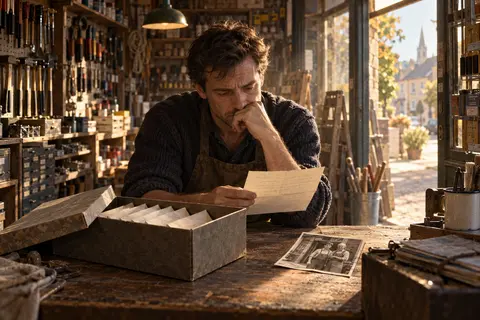
Blanche was no longer in the warehouse when Léonie returned on Thursday morning. Uncle Jacquet claimed that she had taken a day off. He had swollen eyelids and pencil-stained fingers. At the mention of Lucien, he replied too quickly that he did not know any Lucien.
Léonie thought at first that he was hunting her. Then she saw, behind the partition, Blanche's cup still full. His scarf was hanging from a chair. We did not go to rest forgetting his scarf in this cold. The uncle noticed his look, rubbed his face and motioned for him to sit down.
The intermediary had come earlier than expected. Blanche had followed him to speak outside. When she returned, she had asked for money, a sum that her uncle did not possess. She refused to explain what it was for. He had scolded her. She cried, then locked herself in the reserve.
“I thought it was a boy,” he murmured.
Blanche opened up to Léonie after a long time. She wasn't crying anymore. The disappearance of his tears worried more than their presence. She had placed in front of her the bill of her father, the photograph of Lucien and a small woman's watch. Three objects she seemed to have gathered together to determine which one could still save her.
The man had changed the conditions. The warning was to be circulated, but he was now also demanding money for a step concerning his father. He said he ran out of time. He was talking about important people whose patience had to be spared. When Blanche asked him for new evidence, he got angry.
“Did you promise him?”
“I said I would try.”
Léonie sat next to her. The watch was stopped; Blanche went up it again, in small useless towers.
“Did he give you a place to answer?”
"He's coming back."
“When?”
“When he can.”
Blanche stopped turning the crown. Léonie showed him the dateless ticket, but she brought it back to her.
“I know what you’re going to say.”
Léonie withdrew her hand.
Blanche kept the note tight against her.
“If it were Lucien, would you agree to do nothing?”
Léonie looked at the photograph. She recognized the back of the courtyard where her brother had posed, the window of their old kitchen, the empty pot that their mother kept for future flowers. For a moment she was unable to distinguish prudence from cowardice.
“I’d look for something to do that doesn’t give her more lives in her hands yet,” she finally replied. “But I would be afraid just like you.”
This was the first sentence Blanche seemed to believe.
7. Everyone's Faults
Lucien found them in the afternoon at their aunt’s house. He had left the repairman after learning that Léonie had returned to the warehouse. He entered furiously, then saw Blanche and stopped sharply. For a few seconds, they looked at each other without knowing what anxiety to talk about first.
Blanche told him the money. She showed him the ticket. He already knew his existence, but not the new demand. Léonie understood that he too had kept part of the story to spare someone. She wondered how many dangers were thus dressed in good intentions before we could finally recognize them.
“I can sell my bicycle,” he said.
Blanche shook her head. Hearing her propose what she had hoped for in the morning finally allowed her to measure the absurdity of that hope. The man could ask for more. He could disappear. Even paying the full amount would not create the certainty they were looking for. She took Lucien’s hand, not to accept, but to stop him.
They talked for a long time. The aunt prepared a soup that none of them wanted and which eventually gathered them around the table. Lucien admitted that he had opened one of the envelopes. He was afraid of Blanche. Inside were names copied from another hand and a note asking for meeting places.
“Did you give it back?” asked Léonie.
He looked down. He had given it back. Blanche had told him that this information would allow him to contact people who could help his father. He wanted to believe her. Later, he became convinced that not understanding protected him from the responsibility of choosing.
Anger rose at Léonie’s, immediate and almost agreeable. She finally found a clear fault to blame someone she loved enough not to fear losing him. Then she remembered Theodore composing the text on the sole assurance of a service rendered before. She herself had corrected leaves that she never asked where they came from.
“You have to tell Madeleine,” she decided.
Lucien nodded. He did not try to make his fault disappear behind an additional explanation. This simple movement changed the room. They had not solved anything about Blanche’s father. They still did not know who the intermediary was. But they stopped, for the first time since the previous morning, working each in a different ignorance.
The aunt laid three plates. She asked if anyone wanted bread. None of them remembers the taste of this soup. They all remembered that they had eaten it to the end.
8. What We Will Not Shoot
In the evening, the man who came to pick up the copies was waiting in front of the shop. Léonie saw him before he saw her. He wore a dark hat and held a newspaper under his arm that he had not unfolded. Nothing in him matched the monster she had made during her travels. He had a spot of rain on his shoulder, a lace too long, the tired face of an ordinary man.
She came in without speaking to him. Theodore was behind the counter. His wife, Jeanne, stood beside him. She usually stayed upstairs at this time. In front of her, an open notebook and a pair of scissors gave her presence the appearance of an interrupted task.
The man came in his turn. He asked for the program of the concert. Theodore replied that the press had a problem. He did not specify the nature of it. Léonie saw that the real order, perfectly printed, was under the counter. The man lives it too. His eyes rested on the leaves, then slowly went up towards the printer.
“You put more work before mine.”
Theodore did not answer. The silence this time wasn’t reassuring. The man was waiting for a justification to attack him. Jeanne closed her notebook.
“We will not be able to honor your request.”
That was the voice she used with customers she refused credit to. Léonie felt fear in her own throat, but saw no trembling in Jeanne. The man asked for the name of the person in charge. Jeanne gave hers. He asked for the manuscripts. Theodore returned the text for printing. The list was not there.
“Everything?”
“What you asked to print,” Jeanne replied.
He looked at them one after the other. Then he picked up the leaf and went out. There was no spectacular threat or admission. This absence left Léonie more worried than an open anger. They did not know what he would do with the refusal, to whom he would speak, or what part of his power had been real.
When her steps moved away, Jeanne finally placed her two hands on the counter. They trembled so loudly that the scissors produced a little metallic noise. Theodore wanted to take her in his arms; she gently pushed her aside.
“Not now. We have to decide where to sleep.”
Léonie understood then that the story would not end at the time when they would have refused. Refusal was an action; the consequences remained to be overcome. She helped him to prepare the necessary things, taking care not to take away the objects only because they were beautiful.
9. A silent press
The workshop remained closed on the following days. A sign announced an interruption for family reasons. Léonie looked at her from the other side of the street one morning when she should have stayed far away. The words seemed to him to be almost unbearable. They were indeed families: that of Blanche, hers, those whose addresses had circulated on a scrap sheet.
Madeleine returned with incomplete news. Several people had been warned. Others had not been found. No operation corresponding exactly to the text had been confirmed to the addresses she had been able to verify. They did not conclude that everything had been invented. The danger now was also that a lack of evidence would allow them to lower their guard.
The intermediary no longer showed up at the warehouse. Blanche didn’t get a second letter. Uncle Jacquet allowed him to keep his job, but their reports showed for a long time the demand for money and late explanations. He was scared, too. His fear resulted in remarks about delays and accounts, topics he still knew how to talk about without discovering himself.
Lucien continued to see Blanche. Once, Léonie saw them on a bench, too close to each other for their shoulders not to touch, too concerned to realize. She did not join them. She learned that loving her brother did not give her the right to occupy all the places around him.
Theodore found work elsewhere. We had to give up orders, borrow money, leave the press behind. One evening Léonie returned to him the little box of characters brought by Madeleine. She had carried it away at the closing, because it weighed less than a memory and more than a promise.
“You kept the small capitals,” he said.
She almost apologized. He opened the box, observed the small capitals, and then took out of his vest a tiny character that he placed in his palm. An e, worn out on one side, saved from their own breakage.
“You’ll be able to put it back in the right direction.”
He did not tell her that she had saved everyone. They knew too much to use that phrase. He told her that he should have listened to the questions she asked earlier. Of all the confidence he had given her since her apprenticeship, it was the one that cost her the most and that remained for the longest.
10. The full compound name
After the war, Blanche learned that her father had died in custody before the intermediary’s visit. The ticket was genuine, but old. No one could tell him by which hands he had passed. She kept it in the same box as the other letters, without tearing it apart or forgiving it of having been used against her.
Léonie was present when she received the confirmation. Blanche did not cry. She re-read the document, asked if there was a possible mistake, and then stayed for a long time in front of the window. Lucien did not seek a word capable of transforming the news. He sat next to her. This silent patience, of which Léonie would not have thought him capable a few years earlier, made him measure the time elapsed.
The workshop did not reopen at its old address. Theodore and Jeanne joined forces with a colleague; the machines now belonged to several people, and so did the decisions. Léonie came back to work with them. She had changed her hairstyle, less out of coquetry than to no longer find in the ice the face of the girl who believed that a printed text had necessarily gone through all the useful checks.
One day, Blanche brought him a commission. She wanted a few copies of a leaflet for the family, with a photograph of her father and the dates they had been able to establish. She had written a short text. He evoked his way of singing falsely, cutting apples into equal quarters and keeping the buttons in a tea box.
Léonie read these modest details with greater attention than she had previously given to the proclamations. Then she asked if Blanche wanted to sign. This one hesitated. She had never published anything in her life; this verb seemed to her to belong to people of another kind.
“These are your words,” Léonie said.
Blanche took a pencil and added her first name, then her full name. Lucien, who had accompanied her, made no remark. He watched her write as he had watched her, years earlier, hold a note on which all his hope depended.
Léonie composed the sheet. She reread the dates, had the names checked, asked for confirmation rather than correcting a turn she did not understand. The next day, the press resumed its regular movement. She placed the first copy on a table and waited for the ink to dry.
Blanche came to get the leaflets in the late afternoon. She read one standing by the window. Lucien was waiting for him outside with the bicycles. She signaled that she needed a few more minutes.
The bell of the shop tinta.
The man who came in had a new hat. He removed it, asked if the house would accept small private editions, and then put a cardboard shirt on the counter. Léonie recognized his voice before finding his face. She looked at her shoes. The laces had the right length.
“I have been recommended to your establishment.”
He didn't recognize her. At first, she was ashamed of the relief it gave her.
In the shirt were four typed pages and a portrait. A name was inscribed on the cover: André Vidal. He wanted a quote for two hundred pamphlets, he explained. A few memories, a modest contribution. He was encouraged to put them in writing.
Léonie turned the first page. It was about arrests, life-threatening warnings, families he had helped. In the third paragraph, she found the Jacquet warehouse.
The man stretched out his hand to indicate the passage.
“This family can confirm it.”
Near the window, the paper stopped moving in Blanche’s hands.
Léonie saw the moment he noticed her. His finger remained on the name. Then he straightened up and his face took a serious, almost affectionate expression.
“Mademoiselle Jacquet. “Have you heard anything?”
Blanche did not answer. She approached the counter, put down her sheet next to André Vidal’s memories and showed the date of his father’s death.
“Before your visit.”
He looked down. He said that in those days the information was circulating badly. That he had done what he could. A lot of things cost money but didn’t work out.
Blanche put the palm on the four pages when he wanted to take them back.
“You said you could send him a coat.”
Léonie had never heard this detail. She thought of the note, the cold hands, the watch that Blanche had placed in front of her in the reserve. The man was now looking at the door.
“I ask you where his letter came from,” said Blanche.
He spoke of an intermediary. He no longer knew his name. He asked that we understand under what circumstances he had to act. His voice went up a bit. In the studio, the sound of the press stopped.
Theodore appeared behind Léonie. He looked at the visitor, then at the leaves. This time he didn’t ask what work he was being given.
The man took his shirt off the counter. Blanche let him do it. She did not try to block the door. When he left, she stood where he had left her, as if the answer could still come after him.
Léonie had noted the name, the address given for the quote, the time. It could be a false name, but they had something other than an anonymous visitor, a voice in a memory. They would seek to whom to give their testimony. They did not know what would remain, nor how many families this man had actually warned. They knew what he had asked Blanche.
Theodore wanted to take the slip with him to join the copies already ready. Blanche held him back.
“Something needs to be added.”
She took Léonie's pencil. Under the dates, above her signature, she wrote the name he had just given, the 1943 visit, the letter and the money claimed. She spoke one word, replaced it with another, less certain. Léonie waited. Outside, Lucien had leaned the bicycles on the wall and approached the window.
“Do you want me to do it again?” she finally asked.
Blanche reread. She had red eyes, but her hand didn’t shake anymore.
"Yes."
Léonie pulled towards her. For the first time, she was going to compose the name of this man.
He had waited for the end of the war to entrust him to a printing press.
He had chosen the wrong one.
End