1. A package with no address
The painting returned to the museum on a Tuesday, wrapped in a blanket that smelled of laundry. It was the first thing that bothered Iris: someone had washed the laundry before hiding a stolen object. The second was the label, tied around the handle of the carton.
“You can now look for what’s missing.”
The guard had discovered the package in front of the staff entrance at 6:50. He had touched nothing except the door to open it and his phone to call Iris. Since the previous Thursday’s burglary, he had been so told not to touch anything that he seemed to apologize for being still present.
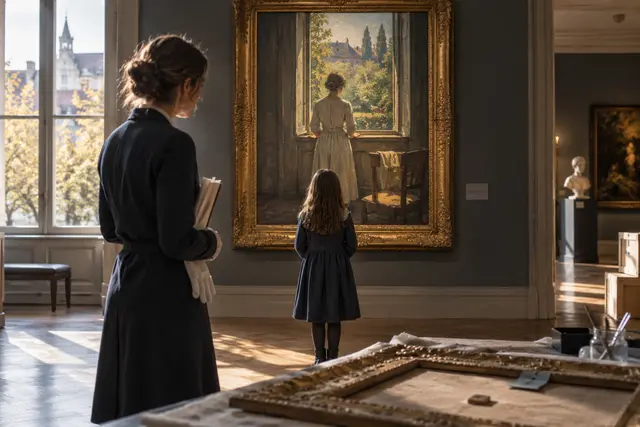
Iris put on her gloves. The canvas depicted a woman from behind, standing in front of a window open to a garden. A small rectangle of light rested on the back of a chair. She knew every detail of this painting: she had examined it before the loan to an exhibition, three years earlier. In her report, she described an old, repaired tear near the left edge. She found it.
— “Is that her?” asked the guard.
— I have to compare.
The answer cost him. Recognising was not demonstrating, and she had already confused the two once in her career. He had never ceased to be reminded of this error, even after his correction.
Captain Abel Roussel arrived before the director. He asked three questions about the hours, two about the keys and none about the value of the painting. Iris was grateful. For five days, the newspapers had found it more convenient to give a price to their loss than to ask what it represented.
The director, Bérénice Dautry, climbed the steps with her coat on her arm. She stopped in front of the canvas. Her face relaxed so abruptly that Iris thought at first that she was going to cry.
— “We must inform the town hall,” she said.
— "We shall begin by checking the object," replied Roussel.
The Musée des Verrières occupied an old merchant house in the centre of Valbrune. His reputation rested on a modest collection and on this woman at the window, painted by Éliane Vercel. Bérénice had been preparing for two years an exhibition that was finally to attract something other than the classes of the canton. Insurance, subsidies and lenders demanded answers. The return of the canvas offered one, beautiful and simple.
Iris gently returned the chassis.
On the reverse, near the repair, someone had glued a small piece of blue paper. He had no signature or claim. Only four words written in pencil:
“Look at the previous Thursday.”
She thought about the robbery, and then realized that it had taken place on Thursday. The previous Thursday was another day, the one where no one stole anything.
At least the one where no one had reported a robbery.
2. The door that had not been forced
The official story was on one page. Thursday night, after the closing, a door to the courtyard had been found half-open. The alarm system recorded a deactivation at 19:12, with the code assigned to Noé Perrin, the young manager. At 7:40 p.m., a round had uncovered the empty wall.
Noah knew he had come back to pick up his bike helmet. He said he closed the door and reactivated the alarm. He was twenty-four years old, a contract that ended in December and an overdraft of which a journalist seemed to know the exact amount. The day after the flight, his name was already circulating without being printed.
Roussel asked Iris if the personal code was enough to identify her user.
— Not if someone saw him.
— Who could see him?
— Anyone was standing behind him. He was said to be cautious because he lowered his voice. It was not his voice that unlocked the door.
The captain noted this sentence without a smile. He had a way of letting people finish that sometimes looked like slowness. Iris was beginning to understand that he was using this silence to hear what the over-quick questions would have replaced.
They found Noah in the assembly workshop. He had been suspended from his duties, but Bérénice allowed him to come and pick up his belongings in the presence of a colleague. On the workbench were two mismatched gloves, a pack of screws and a cup that no one had thought of taking his name from.
When Iris announced the return of the painting, he asked:
— Did they report the frame as well?
The question surprised Roussel.
— Why the frame?
— “Because the picture wasn’t the only one that was expensive.
Iris felt a little movement in her memory. During the hanging, Noah had insisted on photographing the angles of the frame. She had pressed him: the carrier was waiting, the lights were not set, an intern was crying on the stairs. She had interpreted her meticulousness as a way to save time.
The frame, an old construction with two moulded profiles, had arrived at the museum long after the painting. They had been brought together in the sixties. The burglary had separated them: the frame had stayed on the wall, empty.
— “He’s still in the room,” she said.
— “Then you got the right canvas,” Noah replied.
Roussel looked at him.
— Would there be a bad one?
Noah looked down at his cup. He did not answer immediately. Iris heard the snoring of the dehumidifier, the regular squealing of a pipe against the wall. She understood that the boy did not choose between talking and lying. He chose whom he could still talk to.
— “I sent you a message,” he finally said to Iris. Wednesday. Before everything happens.
She found the message in her phone: a photograph too dark, followed by “Do you have five minutes for a detail on your back?” She said, “Tomorrow.” On Thursday, she worked in another city.
Tomorrow had arrived without her.
3. An exemplary restoration
The director proposed to bring everyone together in her office. Roussel preferred separate interviews. Bérénice accepted with a courtesy that made her initial refusal almost invisible.
Iris returned to the empty room. On the wall, the frame surrounded a rectangle of slightly lighter paint. He seemed to be waiting for a face. She lighted the angles, then asked the guard to open the ties. Two people were needed to get the whole thing down to a protected table.
On the reverse, there was a tiny sliver of wood missing in the lower right corner. She found the same accident in Noah’s photograph. But a second detail was different: a rectangular label appeared on the picture, near the crossbeam. On the frame in front of her, this site had only a trace of fresh glue.
— “When was she there?” asked Roussel.
— - Wednesday. The message is dated.
— – A message date is not a shooting date.
Iris nodded. She asked him to consult also the reception photographs, kept on the post of the museum. It was no longer a question of guessing from a phone, but of comparing several series whose origin could be established.
The recent restoration of the frame was offered by a patron, the company Aster Patrimoine. Its president, Léonie Favre, was on all the invitations to the exhibition. In exchange for her funding, she had only asked for a private reception, one evening when the museum would be closed to the public.
This reception had taken place on the previous Thursday.
Iris remembered the cups, the caterer, the flowers too high that hid the cartels. She gave an eight-minute presentation in front of people who continued to drink. The canvas and the frame had just returned from the restoration workshop; Bérénice had wanted to unveil the whole that evening.
— "Who has received?" asked Roussel.
— -Noah.
— And who checked?
— - Me.
The word remained in his mouth. She had checked the painted face, the condition of the canvas, the conditions of the transport. The frame, entrusted to a renowned workshop and returned with an impeccable report, had received only a quick review. She had signed a joint reception for the whole.
Roussel did not reproach him. This made the situation more difficult.
The restorer, reached by telephone, described her work without hesitation. Cleaning, consolidation of two assemblies, limited recovery of an old gilding. She said she never put on a new blue label. His studio used hanging cards to avoid any adhesive on the works.
— Do you have any photos of the reverse?
— Before, during and after. I transmit them to you in the way that you will indicate to me.
The captain gave him the coordinates of the service, then hung up.
Iris looked again at the trace of glue. A famous painting had just been made. Everyone had their eyes on her.
The frame, he had not even been declared missing.
4. The man who knew how to copy
Photographs from the workshop arrived in the afternoon. Roussel had them placed in the file before Iris examined copies. The wood of the old frame had three holes closed on a crossbeam, one of which was off-center. The one in the room had only two, perfectly aligned.
This was not a detail that the cleaning could have explained.
— “A replaced room?” proposed the captain.
— We will see it in the report. And look at the molding here. The breakage of the pattern is in the same place on the facade, but it does not correspond to the same assembly behind.
She placed the photographs side by side. The object had been reproduced to be recognized from the front. His back, less visible, told a different fabrication.
The original frame was gone after its restoration. Someone had brought a copy to the museum, around the real canvas.
Roussel asked for the name of the carrier. The company had made the delivery at 17:00 on the Thursday of the reception, and then removed packing material after 22:00. No painting was officially released during this second passage.
The crates were out.
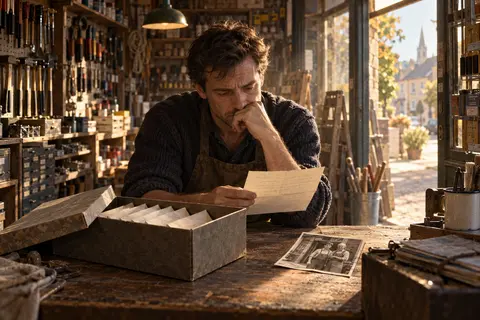
Noah returned at the captain's request. He confirmed that he had seen the label on the reverse during the installation of the work. It had a workshop number and the initials of a craftsman he knew: S. M.
— “Samuel Merle,” he said. He taught me how to repair moldings during my internship.
Iris knew that name. Merle worked for decorators, theaters, individuals. He made remarkable copies and sometimes sold frames made from ancient elements. Copying was not a crime. Presenting the copy in place of an object belonging to the museum could become so.
— Why didn't you tell us?
Noah rubbed the palm of his hand against his thigh.
— I asked him. He replied that it was a commission for photographs. That you knew.
— Who are you?
— - The museum.
The craftsman agreed to receive it. His studio occupied the ground floor of a house near the canal. Wood profiles covered the walls like an alphabet whose letters Iris did not know.
Samuel Merle took out his bill, his purchase order and photographs. He made the copy for Aster Patrimoine. The application referred to a reproduction intended to illustrate a brochure, in order to avoid moving the fragile frame for each session.
— I was asked to age.
— To what degree? asked Roussel.
— “Enough so that he does not swear with the picture. Not to fool an expert.
The craftsman looked at Iris, then at his papers.
— I understand that this distinction has not served much.
Roussel then showed him the photograph sent by Noah. Merle recognized her label even before the captain named her.
— Was she still there?
— Why would she not have been?
The craftsman looked in his phone. He had been asked, the Friday after the burglary, to remove his name from the reproduction. He refused to move without returning the object to him. His studio was on the bill; he could not see why his label interfered with a photograph taken from the front.
He read his answer out loud. Then the last message received: “Leave it, we will take care of it.”
The message was from the day after the theft of the canvas. Iris felt the file tighten around a precise interval. The canvas had disappeared, the frame had remained on the wall, accessible to those who organized the findings and photographs.
— "Keep these exchanges," said Roussel. My colleagues will tell you how to give them to us.
The bill was settled. The name of the client was in all letters. It wasn’t Léonie Favre’s.
It was that of Bérénice Dautry.
5. The price of an exhibition
Bérénice read the copy of the invoice as if it contained a spelling error which it was her responsibility to correct.
— “I ordered a communication medium,” she said. It is not forbidden.
— Where is he now?
— I don't know.
— What about the original frame?
She looked up at Roussel.
— Until now, I thought he was in the room.
Iris wanted to believe it. She knew of Bérénice’s evenings of work, the requests for funding refused, the time spent convincing elected officials that the museum was not a useless piece in the center of the city. She had seen him pay for a train ticket to meet a collector who no one guaranteed would open his door.
Loyalty made every clue heavier, no less clear.
Bérénice explained that Aster had offered to finance the reproduction. She had transmitted the measurements of the original and validated the quote. The copy had to stay with the photographer. For the museum, only the exhibition counted.
— "The photographer has a name," said Roussel.
She gave it.
He had only done one session, before the restoration of the frame. He had never received the copy.
The captain then asked for transport-related exchanges. Bérénice offered to print what was needed. He replied that his colleagues would collect the documents according to the appropriate procedure. She slowly removed her hand from the keyboard.
Outside, the announcement of the return of the canvas had spread despite their request for discretion. A journalist was waiting near the steps. The town hall wanted a photograph of the painting, with the director and, if possible, the keeper who had found it. Roussel asked that no ceremony be held.
— "They'll think I'm hiding something," said Bérénice.
— That is what we are trying to establish.
Iris came down to take the air in the courtyard. She found Noah sitting on an empty crate. He saw her approach and immediately got up, as if he expected to have to clear the passage.
— I’m sorry about your message.
— “You had work.
— That is not an excuse.
He does not contradict her. This lack of consolation seemed to her more just than anything she could have obtained by insisting.
Noah took his place on the box. Iris remained standing, her hands in the pockets of her blouse; she still had her gloves rolled into a ball, at the bottom of one of them.
— I’m going to ask you to give your things back today.
— The cup too?
— "Of course.
— It is not in the inventory. I will be told to wait again.
She didn’t know if he was joking. He scratched a strip of adhesive on the wood, without being able to lift its edge.
— I will come with you.
He finally looked up at her.
— "And then?" Are you hanging up the painting?
— - When we can.
— Everyone is happy, we take the picture.
He had pulled out a piece of adhesive that stuck to his thumb. He rubbed it against his pants.
— That’s what scares me. Let him come back and look for nothing.
Iris looked at the lighted windows of the office.
The phrase was similar to the label.
She didn’t say anything to Noah. She went back to get Roussel.
6. The one who wanted to be watched
Noah did not ask for a lawyer immediately. He asked for a glass of water. Roussel brought it to him, reminded him of his rights, and gave him time to understand that the conversation had changed in nature. It would no longer be an exchange in a workshop, between two shelves.
Iris stayed out. The captain asked him not to participate in the interview. She was a witness, a professional involved, and to an extent she could not yet assess, a person Noah had tried to alert. These roles did not allow him to become the one who would get his confession.
Through the partition, she could not distinguish any words. She waited in a small room where a reproduction of a seascape had been hung. For the first time since the morning, she looked at an image without examining its frame.
The interview lasted a long time.
When Roussel returned, he did not give him all the details. Noah had admitted to having taken the canvas and kept it in a room belonging to his family. He didn’t try to sell it. He said he wanted to provoke an examination of the framework, after his questions had been dismissed.
— Why give it back now?
— “He realized that he had mainly provoked an investigation on him.
The restitution did not erase the theft or the risks taken with the work. Roussel said it without anger. Iris felt an anger of hers, less orderly: against Noah, who had manipulated a fragile picture to force the attention of adults; against Bérénice, if suspicions were confirmed; against herself, who had answered tomorrow.
She asked to see the place where the canvas had been stored, when possible to assess her condition. The captain nodded. This time, his skill had a specific place.
The investigation could have stopped at this first admission. A worried young employee, a bad decision, a work done. But the wrong frame remained there. The bill stayed there. And the photographer denied the justification advanced for its manufacture.
A colleague from Roussel found the first concrete element in the carrier's slips. At the time of the material withdrawal, on Thursday of the reception, a box had been delivered the next day in a warehouse rented by Aster Patrimoine. It was referred to as “promotional decor”.
The driver remembered his weight, not his content. He had no reason to suspect a museum of stealing a museum.
Then the insurer communicated a request received three weeks earlier: Bérénice had requested a separate estimate for the framework. She said a private owner was considering a comparable loan and wanted to understand the cost of coverage.
Iris rereads the document. A separate estimate. She had long explained to visitors that the value of a work was not reduced to its price. Someone had exploited the opposite idea: what surrounded the work could be expensive enough to steal, and remain secondary enough not to be looked at.
7. A debt that was not on the balance sheet
The warehouse no longer contained the frame. Investigators found his box open, protections cut out and a list of deliveries. The departure had taken place on Monday, four days after the reception and three days before the theft of the canvas. The chronology now separated the two gestures.
Noah did not invent substitution to justify his own theft. The first object was already far away when he had taken the second.
Léonie Favre agreed to receive Roussel in the presence of his council. Iris did not attend the interview. She spent the day comparing archival photographs, preparing a recognition sheet and checking the dimensions noted in the old inventories. The three holes of the reverse, an addition of wood on the upper side, the shape of an old repair: as many details less attractive than a signature, but difficult to explain by chance.
The framework had been entrusted to an intermediary for a private sale.
The documents gathered by the investigators revealed a smaller, and more shameful, operation than the large network that a newspaper was beginning to imagine. Aster had advanced a fee for the exhibition. Expected public funding had been delayed. Bérénice had incurred expenses that she no longer knew how to cover.
Léonie had proposed a solution: sell an element of the collection that no one came especially to see. Replace the frame with a reproduction. Use the proceeds of the sale to meet debt and maintain exposure. We could one day buy an equivalent frame, when the inputs would be better.
Iris heard this last justification from Bérénice, during an authorized meeting at the museum to identify certain files.
— It wasn’t for me.
— But you still decided alone.
— Do you prefer to cancel everything?
Iris looked at the boxes of files near the door. She had helped Bérénice to prepare them; on one of them, her handwriting announced the Wednesday workshops.
— “You made me call the lenders,” she said. Last week, again.
— Because I thought we were going to get out.
— You knew what I promised them.
Bérénice lowered her voice.
— “If I had told you that this money was missing, what would you have done?”
Iris put her hand on the box. The felt had crossed the paper at the place where she had underlined “confirmed”.
— “I wouldn’t have called those people back and told them everything was fine.
— They would have canceled.
— "Perhaps.
The director looked at the empty wall behind Iris. His authority seemed to have withdrawn from his shoulders, leaving the coat intact.
— Do you think you would have done better?
— I don't know. I only know you didn't let us try.
This was the first thing Iris managed to say without wanting to take it back.
8. The absent buyer
Finding the intermediary was not enough to retrieve the object. The executive was scheduled to leave the country the following Friday, after a presentation to a buyer. Investigators contacted the relevant authorities. Iris was instructed to be available, along with her photographs and measurements.
The wait lasted one night.
She slept badly and dreamed that she was being given fifty identical frames. She knew which one to look for, but every time she turned it over, someone would clear the holes in the wood.
In the morning, Roussel told him that a corresponding object had been located. He doesn’t say “we have it.” He had learned to reserve the final sentences for the things that were.
The room where she was driven was nothing of a novel setting. A grey table, two neon lights, foam protectors. The frame was laid flat, without a painting. Iris started with the dimensions. She examined the assemblages, the superior repair, the old marks. The three holes were there.
She stopped for a moment in front of a small spout of glue that she had noticed in a restoration photograph. It seemed ridiculous, this imperfection, alongside months of funding and speeches about the future of the museum. She helped to give back to an object her story.
— “That’s the one we’re looking for,” she said.
Then she specified what allowed this conclusion, point by point, so that her certainty did not depend only on her voice.
The buyer had never seen the frame. He had received a file of provenance evoking a family collection. The name of the museum had disappeared. The intermediary claimed to have believed the documents transmitted by Aster. Investigators would pursue this aspect; Iris had neither the information nor the role to decide it.
The return was not immediate. It was necessary to formalize the findings, organize the transport, define the conditions of conservation. Iris welcomed these delays with a patience that would have surprised him a week earlier. Each step produced a trace. Haste had helped the substitution; precision would help the restitution.
Noah was waiting for the judicial suite at his home. He had given the details of his gesture, shown the local, handed over the materials used to pack the canvas. Iris had noticed a slight mark on one edge, with no apparent major damage. She refused to promise that there would be any consequences.
When she phoned him to talk about his personal equipment still at the museum, he asked if the real frame had been found.
— - Yeah.
He remained silent, then whispered:
— “Then it served.
— Your first questions should have been enough. What you did next is still dangerous.
She heard his breathing.
— "I know.
This time, he didn’t say that so we could stop talking to him.
9. The Provisional Cartel
The exposure was postponed by six weeks and reduced by a third. Some lenders withdrew. Others agreed to maintain their participation, provided that the reception procedures changed. The town hall announced an investigation into the management of the museum. Bérénice did not return to her office.
Iris did not become its director. She had made it clear that she did not want her conservation work to be a reward for surviving someone else’s fault. A temporary administrator took over the contracts. They spent two mornings establishing what could be done without promising the impossible.
The frame and canvas were finally brought together in the workshop.
The guard attended the operation. He now knew better the three holes of the reverse than some details of the painting. He asked if they would be shown to the public.
— In a photograph, yes.
— People will believe that it is the holes that make the frame valuable.
— We will explain to them the difference between precious and recognizable.
He thought, and then asked if we could show the copy too.
Iris forwarded the proposal to Roussel and the administrator. The copy remained a piece of the file and could not be installed at their convenience. But a photograph and an explanation would be possible, provided that it does not prejudge judicial decisions.
She prepared a cartel text that took her much longer than expected. "Work found after a burglary" was accurate and insufficient. “Organized theft to save the museum” repeated Bérénice’s justification. “An employee reveals a traffic” turned Noah into a hero without accounting for his act.
She started again.
The final text described two distinct disappearances, the substitution of the frame, then the theft and restitution of the canvas. He said the investigation was ongoing. No character received the comfortable role that would have simplified the whole.
A week before the reopening, Iris found Noah’s first message. She kept it with professional documents, according to the instructions received. Then she looked at her own “Tomorrow.”
It was not a proof of complicity. It was also not a word she wanted to forget.
She proposed a new rule: any anomaly reported on an object would be recorded in a common notebook, with a person responsible for answering it. Not to replace trust with paper. To prevent trust from being used as a reason not to look.
The guard asked if this also concerned his observations.
— Especially yours, she said.
He wrote as soon as the lighting of room three had been vibrating for fifteen days.
This was their first repair.
10. What Surrounded the Light
On the day of the reopening, Iris arrived before the guests. The room smelled of cleaned wood and coffee prepared too early. The woman painted by Vercel was standing in front of her window again. The small rectangle of light always rested on the back of the chair.
Roussel went without a uniform before joining his service. He looked at the painting for a long time.
— Is she waiting for someone? he asked.
— “I don’t know.
— You have to hear this question often.
— And too often give an answer.
He smiles. It was the first time she saw him smile.
The investigation had established the course of the framework and the presumed responsibilities of each; justice would follow its course. The captain promised neither date nor punishment. Iris no longer needed an ending that erases complications to be an end.
Noah did not come to the reception. He had written her a short letter, without asking for a recommendation. He explained that he had found a temporary job in a fitting company and wanted to wait for the next one before deciding on his future. He thanked the guard for taking care of his cup.
Iris had told him that she would send her with her belongings. She added one personal sentence: “I’ll read your questions to the end.”
Around eleven o'clock, a class entered the room. Iris stepped aside to let the children through. They pressed in front of the photograph of the reverse, looking for the three holes like the details of a game.
A boy turned to the canvas.
— Is she the one we stole to find the other?
The mediator began to explain the difference between painting and setting. Iris heard a child ask how much each cost. She continued on her way. She still had the notes of the ready to reread.
In the hallway, the temporary administrator was waiting for him near a table covered with postcards. The attendance of the first weekend was excellent. Groups had booked after seeing the reports. The museum store demanded a second delivery of the photographs of the reverse.
— “This will allow us to maintain the school workshops,” she says.
Iris took a card. There was brown wood, three holes, an old repair. She had made this photograph so that investigators could recognize an object, not for tourists to send it to their friends. But nothing was wrong with his legend.
— What about the ones in the painting?
The administrator showed him a pile still surrounded by his strip of paper.
Iris stood for a moment with the card between her fingers. Bérénice had sold the frame to finance the exhibition. The scandal of this sale was now bringing in the visitors she had longed for. Iris would have liked this idea to have only caused her disgust. She thought of the mediators’ contracts, of the workshops maintained, and rested the card without answering.
In the room, the visit ended. One child stayed in front of the painting while the others walked towards the exit. She held her pencil over a sheet, with the anxious concentration of someone who couldn’t reproduce what he saw.
— “Do you draw the lady?” asked Iris.
— - The chair.
The child showed him his drawing. She had drawn four feet, a backrest, and then a yellow spot that was too large.
— I can’t make the light. If I color, it looks like she painted her chair.
Iris looked at the canvas. Since the return of the package, she had examined every mark, every edge, every wound. She had not once tried to understand how Vercel had laid this rectangle of sun.
She squats near the child.
— I don’t know how she did it either.
The mediator saw them and indicated that they still had a minute. Iris stayed there.
Outside, we continued to buy the three holes.
End