1. A chair in the middle of the track
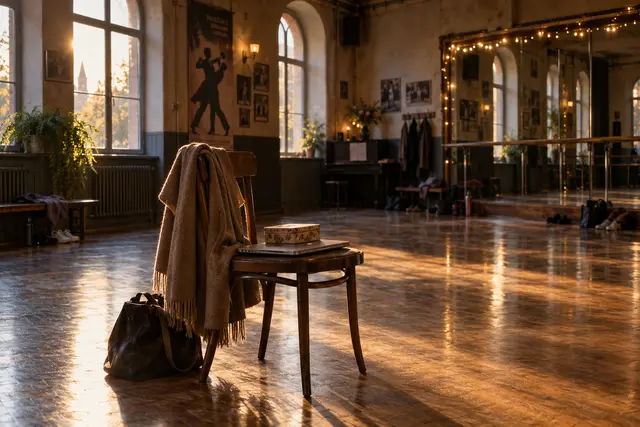
The first time Lise entered the room of the Fougères, Adrien asked him to move his chair. She had put on her computer, her coat and a box of cookies purchased to cajole the members of the association. She thought he wanted to help her. He was simply pointing to the middle of the track.
“Here, we turn.”
“I don’t want to stay long.”
“Neither do we. We always come back to the same place.”
She looked up at him and saw that he was smiling. It irritated him more than if he had been unpleasant. Since the beginning of the week, everyone seemed to consider his work file as a personal offense. She was an architect in charge of renovating the municipal hall. She had neither decided to close it nor asked that it coincide with the spring when the dancers were planning their big ball.
Adrien taught here two nights a week. He moved the chair to the wall, then asked if the parquet would be kept. She said the diagnosis was not complete. He asked if the mirrors would stay. Same answer. On the third question, she opened the box of cookies.
“I can offer you something certain.”
He took one. Around them, a dozen people arrived with shoes in bags, bottles of water and the quiet familiarity of those who own a place without owning it. A white-haired woman kissed Adrien, greeted Lise, and sat down to change shoes. On his stockings, a seam had been taken up with pink thread.
“She’s my mother,” said Adrian. She will give you advice on acoustics, windows and probably your sentimental life. “You only need to feel for the windows.”
His mother gave him a look to which he replied with an absurd reverence. Lise smiles in spite of herself. She had come to measure openings; she was beginning to understand that she should also listen to the people who passed by.
The course begins. She stood by the wall, her notebook on her knees. Adrien wasn’t dancing like the men she’d seen on TV. He did fewer things, but seemed to do them exactly when they became necessary. When a beginner got the wrong foot, he got the wrong foot and turned their hesitation into laughter.
Lise looked down at his plan. For the first time of the day, a straight line seemed to him lacking in imagination.
2. The six-week contract
They met three days later in front of the closed door. Lise was ahead of time for her technical visit; Adrien was looking for a key that her mother had mistakenly carried away. The rain forced them to squeeze under the small awning. He offered him half of his umbrella, but the canvas was holed in the middle.
“It’s a pretty bad half,” she observed.
“Both are. I didn’t want to create inequality.”
She laughed honestly this time. He seemed surprised, as if she had just shown him a room in the room that he had never noticed. They waited ten minutes. He asked her where she came from. She replied that she had grown up twenty kilometers away, then lived in Lausanne, then recently opened her own office in the region. She worked too hard and still pretended it was just a start.
Adrien told him that he would go to Lisbon in six weeks. A school offered him an eight-month contract. He had wanted it for a long time, but the announcement had arrived at a time when his mother was alone and the association needed him to prepare the last ball before the work.
“Are you going to refuse?”
“No. The contract is signed.”
He watched the rain fall from the edge of the awning.
“My mother says she’s happy. Then she asks me who will open the room on Tuesday.”
“Is it only you who have the keys?”
“No. That is the problem.”
She thought of her office in Lausanne, of the boxes that were still being crossed the day before her departure. She too had been waiting for a practical question that would force her to stay a little.
At last, Adrien’s mother, Colette, asked her if she would come to the ball. Lise replied that she could not dance. Colette stated that this was not an answer to the question. Adrien, who was stowing carpets, observed it without intervening.
“You have six weeks left,” her mother concluded.
Lise could have invoked the work. She almost did. But Adrien offered him a group test class, without commitment and without demonstration in front of everyone. He says so without insisting, by really giving him the opportunity to refuse. It counted more than he could guess.
She agreed for the following Tuesday. As she left the room, she consulted her schedule and deleted a meeting she had planned with herself. She couldn’t remember the last time someone gave her a reason light enough to move work.
3. What a Hand Asks
The first class was a limited disaster, which was already good news. Lise walked on the foot of a retiree named Bernard, forgot three times in which direction to turn and apologized so often that Bernard ended up asking him if the apology was part of the choreography.
Adrien did not give him any special treatment. He would move between couples, correct a position, play new music. She was disappointed in his discretion, then ashamed to be disappointed. She did not yet know what she expected of him; she only discovered that the expectation existed.
At the break, he brought her a glass of water.
“You anticipate all movements.”
“I try not to miss them.”
“So sometimes you do the one that hasn’t been asked.”
She raised her eyes to heaven. He immediately recognized the error of formulation and laughed.
“It sounds like a lesson in life at a very bad price. I’m just talking about dancing.”
He asked her if she wanted him to show her with his hands or just look at her. She chooses to dance. His palm was warm, the pressure was light. He waited for her to find her balance before moving. For someone used to dealing with emergencies invented by others, this second of waiting had something almost unreasonable.
They took three steps. He did not anticipate the fourth. He came without hesitation, and then another. She raised her head and met his eyes. No feat had occurred; they had only crossed a few meters without getting in the way. Yet she felt a lively, disproportionate joy, which made her want to start again immediately.
After class, they put the chairs away. Adrien asked him if he could help her. She replied that she thought she had already walked on her feet with enough privacy to do so. He explained that he made an important distinction between his feet and the rest of his person.
They came out last. The rain had stopped. Lise refused a coffee because she still had plans to finish. She regretted her answer before reaching her car, but did not return. In the rear-view mirror, she saw him close the door, check the handle and stand still for a moment under the awning.
The next day, she wrote to him to offer the coffee she had not been able to accept. She reread her message six times, then sent it before finding a seventh reason to correct it.
4. The Things We Take Away
Adrien arrived with a small cardboard box. Lise thought of a gift and felt a disproportionate panic. He placed the box on the coffee table, opened it and pulled out a handful of screws.
“Colette asked me to show you the windows. I explained to him that we didn’t have an appointment for that. She asked me if you would stop being an architect for an hour.”
Lise examined the screws, because she was unable to resist a concrete question. Then she closed the box and pushed it into the middle of the table like a third guest, whom they asked to be quiet.
They talked about work, first, and then about what they had done before their current work. Adrien had spent years accepting replacements, teaching in rooms that were too small, and explaining that dancing could be a profession. Lise had learned to present a project without implying that she wanted us to love her. She had sometimes confused this skill with the ability to expect nothing from others.
He asked if anyone was waiting for him in Lausanne. She replied that a relationship had ended there eighteen months before. Nothing spectacular: many decisions postponed until there is no more room for a common decision. Her former partner was waiting for her to work less. She was waiting for him to understand why she was working so hard. They were only waiting for the end of the conversation.
Adrien did not say that he was different. He told her of his own tendency to turn problems into jokes, especially when a serious response might displease. He had left someone with so many reassuring signs that the breakup had seemed to fall from the sky. He was ashamed of it.
This imperfect frankness pleased him more than a promise. They came out of the cafe and walked to the lake. A cold wind turned the water against the stones. Lise wore unsuitable shoes; Adrien offered to slow down without commenting on his choice. She discovered with surprise that she might want to kiss someone at the exact moment he wasn’t trying to be seductive.
It was she who stopped. He stopped talking. For a second, she thought of Lisbon, the six weeks and everything that could make this gesture unreasonable. Then she asked him if he wanted to kiss her.
He answered yes, without joking. She thanked him even in the kiss.
5. The video
For two weeks, they invented a proximity made of small displacements. He would see her at the office with a meal when she forgot the time. She was attending the last quarter of the class to help him tidy up. They spent a Sunday setting up a shelf at Colette’s, who let them argue with a note while pretending to get coffee.
Lise was always working too hard. Adrien continued to prepare for his departure. Neither of them presented it as an obstacle disappeared by the virtue of the first kiss. They talked about it, but often late, when they were tired and happy enough to prefer a simpler question.
The problem happened on a Thursday, in the form of a video. A member of the association had filmed a session dedicated to the future ball, with the agreement of the people present. Lise appeared to be explaining that the room had a value that no plan could measure. She then talked about the necessary work and the constraints, but this part had not been preserved.
The video called to save the room from its transformation. His name and quality of architect were below. Adrien shared it on the account of the association. The message gave the impression that she was disavowing the project she was tasked with leading.
She called him immediately. He replied that he had not written the montage, that he had especially wanted to show the importance of the place. She asked him if he had looked at her to the end. He admitted that he did. She waited, hoping that he would understand the next question without forcing her to formulate it.
“I thought you’d agree on the substance.”
“You could ask me.”
He made a clumsy joke about the need to sign a license before each sentence. The silence that followed told him as soon as he had chosen the worst way to escape his discomfort.
Lise asked him to remove the video and publish a correction. She specified what was wrong, what she had actually accepted and why she did not want to become the guarantor of a campaign she had not chosen. Then she hung up before her anger turned into something else.
An hour later, the video was no longer available and the correction was published. Adrien sent him a capture, accompanied by a sober sentence: You are right. I used you to convince. She rereads these words for a long time, without knowing yet what she could do with them.
6. The space between partners
They met on Saturday morning, at his request, in the empty room. Lise had chosen a familiar place and an hour at which no class would force them to interrupt the conversation. She didn’t want to make a scene for him or accept excuses too quickly to regain the comfort of the night before.
Adrien had made coffee. He did not propose it immediately. He waited for her to put on her coat, then told her he was sorry. The sentence contained no buts. She noticed this detail with almost professional attention and hated having to evaluate it that way.
He explained that he was afraid to leave leaving the association without a room. The work was likely to last; some students would not come to the replacement place. The success of the video made him feel like he was finally acting on something. He had understood too late that this efficiency was partly based on the distortion of his speech.
“You could have supported the room with your own words,” she says.
He nodded, then took out his phone.
“I can call the chairman of the committee. Explain it to him...”
“She already has my explanation.”
He put the device near the cups. Lise opened her bag and drew from it a sheet folded in four: the report of the meeting of the day before. One sentence was underlined. Any external communication from the architect regarding the construction site would now be subject to prior validation.
“Before Thursday, I wasn’t asked that.”
Adrien read the sentence twice. Then he pushed back the phone, so abruptly that a little coffee passed over the edge of his cup.
“I thought you were defending the same thing as us.”
“I also defend people who can’t get in here with a chair. You don’t see them in your classes.”
He looked at the double door. One of the flappers had been condemned for years by a piece of furniture where they stored the discs.
Lise took a towel for the coffee. He held out his hand to her and picked up the cup himself. For a moment, they only had to do this: prevent a small puddle from falling on the floor.
Lise told him that she had to explain the video to the municipality. The project was not abandoned; neither was his contract. However, something had been weakened. She didn’t want him to promise to immediately fix everyone’s trust. She wanted him to understand that the consequences did not go away the moment he acknowledged his mistake.
“What about between us?” he asked.
She looked at the track. On the floor, small marks indicated the places where couples began certain exercises. She would have liked that there were such clear markers to resume a relationship.
“I don’t know yet. But I have come.”
They drank the coffee that had become lukewarm. He asked if he could continue to write to her. She answered yes, provided she didn’t send him ten messages to check if she was forgiving him. This time they both smiled.
Before leaving, Lise placed on the table a drawing of the future room. One solution was to retain some of the elements to which the association was attached, subject to ongoing audits. She had worked on it before the video. She wanted him to know, because she refused to let her work become retrospectively a reward or a sentimental punishment.
He looked at the plan without touching it. “Thank you for showing me,” he said. For this morning, that is enough.
7. The Ticket
The following week, Adrien received his ticket to Lisbon. He told Lise the same night. The departure would take place on a Tuesday, three days after the ball. He had to arrive early enough to meet the team and prepare for his first classes.
She knew he would leave. The knowledge did not prevent the precise time of the flight from hurting her. Until then, Lisbon had been a city with plans; it became a check-in counter, an authorized suitcase and a morning where you would have to get up before daybreak.
They ate dinner at her house. Adrian noticed that she had prepared enough food for four people. She replied that she had not found a suitable portion for a difficult conversation. He laughed and then asked her what she really wanted for the next few months.
“What if you don’t want to call anymore?” she asked.
Adrian put down his fork.
“You mean because I’ll be tired, or because it’ll be me?”
“I just can’t tell the difference.”
He looked at the dishes on the table, enough to prevent them from cooking for three days.
“I’m going to start classes, look for an apartment. There will be missed nights. I’d rather tell you.”
“It’s not very salesmany.”
“I can start again with my umbrella.”
She smiled, then asked him what nights he would really have time. We had to look: her classes ended late and her meetings often overflowed. Lise picked up her phone.
They took out their calendars. The gesture at first seemed terribly unromantic. Then she realized that he was looking for a real place with her. Not a statement large enough to commit anything. A possible visit in June, calls that would not always fall during his classes, permission to say that an arrangement no longer worked.
They did not set eight months of happiness. They decided to begin with six weeks after his arrival, and then to speak honestly about what that period would do to them. The duration made her smile: six weeks had been enough for a stranger to ask her to move a chair and upset the use of his evenings.
Later, when he placed his head against her shoulder, she felt how much she would have liked him to stay. She did not turn that desire into a demand. He did not pretend not to understand it.
They stayed there for a long time, in the small kitchen where the plates were waiting. Nothing was settled forever. For the first time, this lack of guarantee did not necessarily seem like an absence of love.
8. The Unexpected Dance
On prom Saturday, Lise arrived early to help set up the lights. Work would begin two weeks later. A place of replacement had been confirmed for the courses, less central and less beautiful, but accessible. The association had obtained schedules that would allow it to continue. No one said it would be exactly the same.
Colette welcomed the volunteers with a notebook covered with scrapes. She gave Lise a box of pins, and then asked her if she had brought her dancing shoes. Lise picked up her bag. Colette had a satisfied smile and for once abstained from any comment.
Adrien was supposed to open the evening with a demonstration. His usual partner, Camille, had arrived from Geneva for the occasion. He watched them repeat. Their common ease gripped her with a jealousy of which she was not proud. They understood each other at a speed she might never reach.
Camille came to greet her, spoke of her own companion, and asked her if Adrien had already inflicted her jokes on her feet. Lise discovered that a feeling could lose some of its strength as soon as one met the person on whom it had been projected.
The ball started. There were too long speeches, a capricious microphone, glasses placed in the wrong places. Then the music finally took its place. Lise danced with Bernard, who declared that his feet now had a reasonable life expectancy. She danced with a woman she didn’t know and made a mistake without asking for forgiveness three times in a row.
Adrien invited him later. He doesn’t choose the easiest or most impressive music. He chose the one they had listened to on calendar nights. Lise recognized her after a few notes and felt her face change before she decided to smile.
They started slowly. In the middle of the piece, she forgot the expected movement and stopped. Adrien stopped with her. She laughed; he waited. Around them, the other couples continued to turn.
“I don’t know what’s next,” she murmured.
“Neither do I. You were the one who invented it.”
She took his hand, proposed a step and felt him follow her. This was the first time she didn’t find out which of the two was driving. The track had not become bigger. They had each ceased to occupy a rigid half of what could happen to them.
9. The Last Invitation
At one o'clock in the morning, Colette asked for the microphone. Lise dreaded a farewell speech. Adrien too, judging by his way of getting closer to the cables as if he were looking for a technical reason to disappear.
His mother announced that she would not resume the presidency of the association at the beginning of the school year. A murmur passed through the room. For years, everyone had been saying that it was indispensable, and everyone had taken this formula as a reason to never ask her if she wanted to continue.
She had found a team to share the tasks. Now she wanted to come dance, sometimes help, sometimes leave before the end. She thanked the volunteers, greeted Adrien’s departure, and then added that she too had booked a trip. Not in Lisbon. In Italy, with a friend whom his son barely knew.
Adrien looked at her as if she had just announced that she was changing jobs. Lise felt a tender laugh rise which she held to give her time to understand. For weeks, he had been trying to leave his mother without abandoning her. He had no idea that she too could prepare a departure.
“You could have told me,” he whispered as she came down from the platform.
“I just did it.”
Then Colette took his face in his hands and told him something that Lise did not hear. Adrien closed his eyes for a second. When he opened them, he looked both sadder and lighter.
The last dance did not belong to them. Colette chose Bernard; Camille invited a beginner; a man who had not left his chair of the evening finally got up. Lise stood for a moment at the edge of the track to look. She understood that this place could count in her life without all her stories revolving around her.
After the guests left, Adrien and she picked up the forgotten glasses. He told her that his mother had been afraid for months to become the respectable reason why he would give up his plans. Lise thought about the decisions they sometimes made in place of the people they wanted to protect.
They left last, as after his first class. Under the awning, Adrien kissed her for a long time, without trying to make this kiss a perfect memory. He felt the warmth of the room and the fatigue.
“Can I come with you to the airport on Tuesday?” she asked.
He replied that he wanted it. She was happy to have asked for it, instead of guessing once again what an independent person was supposed to do.
10. The first appointment after
Tuesday came without respecting the slowness they would have wanted. In the car, Adrien checked his passport three times. Lise was driving and making fun of him nicely, until he noticed that she had kept the same song on a loop since they left.
They drank too hot coffee in the hall. It was necessary to speak of luggage, doors and schedules because these details prevented the minutes from becoming entirely solemn. Then the announcement of the boarding forced them to stand up.
Adrien asked her if she regretted the first class. She replied that she mostly regretted not having started earlier, but that it would have been with another teacher and therefore risked unnecessarily complicating the conversation.
He laughs. She held him in her arms before the laughter disappeared. She would have wanted to tell him a sentence that contained their hope without giving it the form of an oath. She only found, “Call me when you can really tell me.” He promised that, and no more.
The first few weeks were less elegant than their last dance. A call fell during an extended meeting. Another began with fatigue and ended with an argument about a message that was too brief. They also had funny conversations, pleasant silences and an evening where they cooked at home with very different results.
After six weeks, they did what they had agreed; they talked about it afterwards. Adrien had found his rhythm. Lise had hired a female employee for a few hours a week and started to reserve some evenings for something other than emergencies. None had changed their lives just to make the other happy. However, their lives became easier to bring together.
She came to Lisbon in June. At the exit of the metro, he was waiting for him with a new umbrella and two perfectly sealed halves. She put down her suitcase to kiss him. He had lost a little; she had not noticed it on the screen. He took her suitcase, returned it to her to go down a staircase, and then wanted to take it back. She finally gave him her bag. They laughed at their inability to organize ten meters of reunion.
After dinner, he offered to show her a room where we danced on Fridays. He knew the way. In front of the entrance, however, he stopped to consult a poster that he seemed to know by heart.
“Is this where you come from?”
“I’m going ahead.”
She waited for the next one. He folded the sleeves of his shirt, unfolded them.
“Three times already.”
Inside, a woman laughed too loudly. Someone was beating the measure on a table. Nothing like an entrance exam.
“Do you know people?”
“Precisely. No, no."
Read him. The man who found a joke for every crushed foot was now avoiding his eyes.
“At the Fougères, when I arrived, we needed the keys, music, advice. At school, the same. But if I go in there...”
He opened the door without finishing.
She thought of the stories of his evenings, of the meals he said he took late, of the fatigue of which he made such a funny account. She had told him of her own difficulties in filling Tuesdays. He encouraged her to go out.
“Why didn’t you tell me?”
He had a small smile that he gave up before making an answer.
“You already had enough reason to ask me to come home.”
She was injured for a few seconds. So he had imagined that she was waiting for a failure, an opening in her new happiness. She was looking for a phrase that would make her understand that. Then she saw her hand on the poster, fingers that mechanically smoothed a corner peeled off.
“I don’t want you to come home because you’re having dinner alone. I want you to be able to tell me you’re having dinner alone.”
“Okay.”
She wasn’t sure he would be able to do it the next day. She also didn’t know if she would listen to him without hoping for his return.
They came in.
Adrien chose two chairs near the wall. From the first dance, he pointed to a couple and began to explain a trip to Lise. She let him finish. At the second remark, he interrupted himself.
“I am painful.”
“A little. You can also ask me if I want water.”
He went to get some. During his absence, a man invited Lise. She hesitated, looked for Adrien, and then stood up. She didn’t know the piece and not her partner at all. In the first round, she was wrong. The man changed his movement without seeming to grant him a favor.
When she returned, Adrien was waiting for her with both drinks. He made no comment on his steps.
“You look good.”
"I'm fine."
She drank, put down the glass and held out her hand. He got up too quickly, hit his chair and wanted to push it against the wall.
“Leave it,” she said. Come on."
For the first time since she knew him, he had cold fingers.
They joined the others in the middle of the piece. No one turned to look at the teacher. No one expected him to leave.
After a few steps, Adrien stepped on his foot.
He apologized. She asked if the apology was part of the choreography.
His laughter was so sudden that they had to stop. Behind them, their chair went past in the passage. A man put her away without interrupting her conversation, and they continued to dance.
End