1. A box for light
The car was more expensive than the crossing. Léna knew this because her employer had pointed out her price on the assignment voucher, just above the instruction: do not pose on the side. Inside, wedges were shaped like a lens that she had only seen in photography. On Tuesday, she had to dismantle this room in the old lighthouse of Brown Island. On Thursday, she was supposed to take it back to the port museum. Between the two, there would be nineteen meters of stairs, six old bolts and two apprentices si if it included Renaud, who was keen to come.
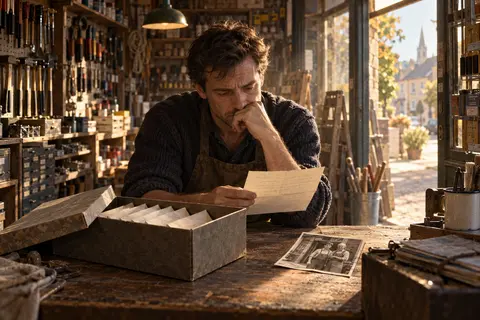
Renaud was sixty-eight years old and said he had spent his life in this lighthouse. His right knee seemed to have spent his life elsewhere: he hesitated before each step of the platform. He had loaded a canvas bag and a package wrapped in a towel. To Léna’s question, he had answered: a cake. Then he had watched the crate with fatherly severity in front of the first bike without wheels.
The real apprentice was Sami. He had been working with Léna for three months and still had the painful habit of saying that he knew how to do it before the work had been explained to him. Nevertheless, he had thought of the spare batteries, the second lamp and the gloves that Léna had allowed to dry in the workshop. She had given him the notebook of the coins to be inventoried. He had slipped it into the inside pocket of his jacket like a diplomatic document.
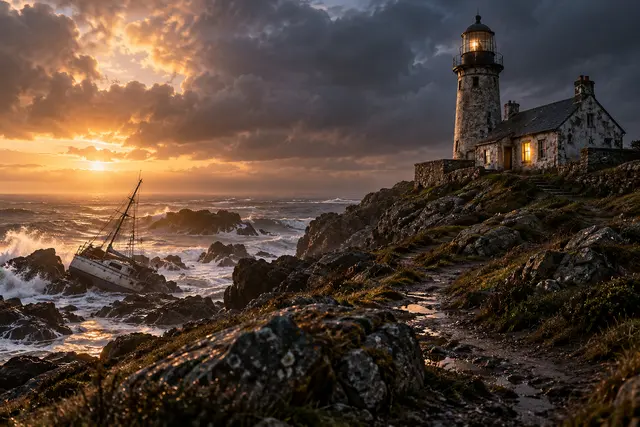
Joëlle, the owner of the small boat, made them look at the white dot that now indicated the island. The modern fire was on a low pylon, away from the old building. Dismantling would therefore not change navigation. The old lighthouse had not been lit for twelve years.
— "What if the weather turns?" asked Léna.
— - We shorten your stay. We don't shorten the waves.
Joëlle showed him the fixed radio near the gate of the house of the guards, the serviced emergency room and the path that led to the south cove. It was their point of retreat if the pier became impassable. They resumed the scheduled hours of contact. Renaud listened as he turned a small key in his fingers.
Passing the threshold, Léna noticed an inscription on the frame: REN, in deep letters, then another, almost erased, YV. Renaud placed his bag in front and asked where she wanted to install her equipment. She thought that the places where one had been happy must sometimes be difficult to show.
2. Things that resist
The house smelled of salt, cold paint and damp rag. In the old kitchen, authorized visitors left reservations and dated their passages on a painting. The last interview was nine days old. Léna checked the equipment before going up. Sami tested the lamps. Renaud opened all the shutters, except the one that led to the south cove.
The lens rested at the top of the lighthouse in its metal cradle. The large surfaces of glass, crossed by the day, returned pieces of sea to the walls. Léna immediately understood the price of the box. She also understood that the six bolts had no desire to join a museum. She announced to Sami that they would start by observing, photographing and spotting, which obviously disappointed him.
— It was said that I would disassemble.
— “To disassemble, you must first know how to reassemble.
Renaud smiled. He knew the phrase. When Léna asked him for the order of the pieces, he pointed to a small box behind the landing. Inside, a notebook contained surprisingly accurate drawings and pencil remarks. Several pages were signed Yvonne. Under a drawing, an almost erased line indicated: “Main light stopped. Watch over the lamp.” Léna spotted the cradle diagram, kept the page open, and raised her head.
— "My wife wrote better," said Renaud.
It was noon when Joëlle called. Depression was progressing faster than expected. She would return on Wednesday mid-afternoon, before conditions really deteriorated. If the wind preceded her, she would not attempt the pier. Léna confirmed. They had enough time to secure the lens, maybe to get it down. She promised nothing more.
After the meal, Renaud wanted to carry a box to the top. His knee dropped to the third step. He caught up to the ramp without falling, but the sound of his breath stopped Sami. Léna took the box. Renaud protested with disproportionate violence. She waited until he had finished, and then offered to sort the accessories in the kitchen. He sat, vexed, in front of pucks whose name he knew before he was born to her.
In the evening, the cake was divided into six parts. Renaud reserved three for the next day, with the precision that betrayed a long practice of places where nothing can be bought. Sami asked him if he had ever been afraid here.
— “We didn’t stay if we were afraid,” he replied.
A moment later, he added, much lower:
— That’s what they were saying.
Léna looked at the shutter closed. Outside, behind the wood, the sea had already changed its voice.
3. The Orange Garment
On Wednesday, they began at seven o'clock. The light was grey, the wind still moderate. The ties had finally given way without damaging their support. Léna had prepared the descent with her lifting equipment; she checked each step and refused the extra hands where they might interfere. At eleven o'clock the lens rested in his crate on the ground floor. Sami photographed the last hold with a huge smile.
Renaud did not look at their work. He looked at the sea through a slit between the closed shutter and its frame. Léna at first thought that he regretted the disassembled piece. Then he said there was something in the rocks on the other side of the point.
They went out to the wall. Downstairs, a clear hull appeared between the waves. She was leaning against a slab, too close to sail, too far from the pier to have chosen this place. An orange dress moved higher. Someone was waving an arm. Léna felt that particular second in which a figure becomes a person and one ceases to be able to continue his day.
She returned to the radio. Rescue workers had received a distress call from a boat whose engine had broken down. The contact was interrupted before the situation on the ground was confirmed. She could specify what they saw: two people on the rocks, one standing, the other motionless but conscious, as far as she could judge. He was asked not to go down the cliff. She had no intention of it.
Renaud knew a path behind the old vegetable garden. At the fork, the left branch joined a small platform above the slab, without passing into the water; the one on the right went towards the south cove. Léna asked him if the road had been maintained. He first answered yes, then corrected himself: there was the last time he had come. Four years ago.
She took the blankets, the portable radio and the local kit. Sami was carrying water. Renaud remained at the fixed station after describing the departure of the path. Léna insisted until she obtained her agreement, then made her repeat the hour at which she would give news.
The trail was overgrown, but legible. They moved slowly. At every turn, Sami wanted to call to reassure the castaways; Léna asked him to wait for a passage where they would not need their breath. She was less afraid of emptiness than of a hurried gesture, a foot resting because a voice was waiting.
The person in orange was a young woman. When she finally recognized them, she did not cry out for help.
— “My father says he can walk,” she said. Don't believe it.
4. The One Who Could Walk
His name was Luke and his daughter Daphné. She was twenty-six. They had gone to bring this boat together and had already made three stops. She began to name the next port, then looked at the hull and closed her mouth. Their journey had just lost its future.
Luc had hit the railing when the boat had hit the rocks. He had managed to land with Daphné’s help, but his ankle had swelled. He trembled more than he wanted to admit. Léna transmitted the information to the station and followed the indications received to shelter them from the wind in the meantime. She didn’t try to name an injury she couldn’t recognize.
The helicopter planned for the area could not intervene at this time. A rescue boat was mobilized, but the exposed coast of the island complicated the approach. We had to get home if Luke could be transported without adding any danger. Carrying equipment was in the room. Sami immediately offered to go look for him. Léna had him describe his return by the path before letting him go.
Daphné knelt beside her father. She spoke to him with gentleness and almost invisible anger. He always said he could get up. When he tried to do so, his face turned white. He sat down and, for the first time, looked at her without discussion.
— "He hates to disturb," she said to Léna.
— The least disturbing thing is that he listens to us.
The sentence made her laugh only once, a dry laugh that turned into tears. She wiped them immediately. Her father wanted to take her hand; she moved to hold the blanket, without knowing if she had avoided the gesture or only the wind.
Sami returned with Renaud. Léna opened her mouth to protest, but the old man explained that he had warned the rescue from the fixed station before leaving: they knew the house was temporarily empty. The contact would remain possible through Léna’s portable device. He wasn’t going to wear. He knew the passages where the path changed level, and could prepare before them the necessary space. She would have preferred another organization; it was now there. She told him never to leave her sight.
The return lasted much longer than the descent. They often stopped. Sami no longer said he knew how to do it. He asked where to put his hands, announced when to blow, started again. Léna saw him lose his desire to impress and gain something more solid.
When they reached the garden, the house seemed gigantic. Luc, transported inside, asked his daughter for forgiveness.
— “For what?” she replied.
He could not choose.
5. The cut photograph
At three o'clock Joëlle gave up docking. She had tried to reach the area from the port and turned around before finding herself engaged with no reasonable way out. His voice on the radio was no excuse. Léna confirmed that the five people were in the house. The rescuers knew their position and re-evaluated the possibilities. An improvement could happen at dawn. It could also shift.
Sami rearranged the beds. Daphné checked the dry things that were lent to her and hung her father’s clothes. Renaud prepared a soup by moving pots with the assurance of someone who had used them the day before. Léna gathered the reserves, counted the water and established with each one the possible tasks. The work calmed down better than the promise of good weather.
In the pocket of his wet jacket, Luc had saved a plastic photograph. Daphné placed it against a bowl. There was a boat similar to theirs, two teenagers, a bearded man. The name of the ship was the same. Luke explained that he had bought, almost by chance, the boat on which his father had taken him when he was young. He wanted to do a piece of their journey with his daughter.
— "You could have started by asking me," said Daphné.
Léna understood that she was not talking about the journey. Luc lowered his head. He had announced to the rest of the family that Daphné would come to work with him at his shipyard upon his return. She had accepted a crossing, not a future. The breakdown had not created their conflict; it had only deprived him of doors to slam.
Later, while looking for sheets, Léna found in the back of a closet a photograph of the lighthouse. Renaud posed there with three men in front of a boat. The edge had been cut. Someone had stayed out of the frame: a hand still held a mooring, in the right angle.
She recognized the image reproduced in the museum file, captioned: Renaud Valet and the December rescue team. She didn’t remember the year. The text described a night when the guards welcomed the crew of a cargo ship. The museum wanted to tell this story with the lens.
Renaud surprised her with the photograph.
— “She didn’t like his head on it,” he said.
— Yvonne?
He took the sheets, without taking the picture. On the stairs, her knee made that little noise she had already heard at the dock.
— "That's what I told the journalists," he added.
This time, Léna did not let him divert the conversation.
6. The person in the corner
Yvonne was the keeper. Renaud said it with a stroke, like a man who dives so as not to stay on the edge. He was working on the interview. They had lived here together for almost twenty years. During the rescue, he had followed his wife’s orders, welcomed the men she was bringing back and heated the blankets. He was not ashamed of these gestures or reason to have them. But the next day, when a photographer had called him the caretaker, he had not corrected.
— “Why?” asked Léna.
— Because I liked it.
The simplicity of the answer disarmed her. He did not invoke the time or the journalists in a hurry. Yvonne knew her job, he said; she didn’t need the article. He had used that phrase for years not to look at what it cost him. Then the narratives had resumed the first narrative, and each repetition had made the correction more humiliating to his eyes.
— Where is she now?
— "At his sister's. She left me three years ago. Not for a photograph. Well, not for one thing.
The package in the towel came from her. They were talking. She had given him the cake and the keys, after having made him promise not to play the chef. Léna thought of the precise little notebook, the initials hidden by the bag, the flap in front of which he had hesitated. He wasn’t just afraid of the sea. He was afraid of a museum that would finally freeze his version.
— “I was going to bring back the notebooks,” he said. Explain by giving the objects. It was easier than coming with nothing.
— expliquer You can explain without the lens, if we have to leave it.
He looked at her, worried for the first time about what she already knew: the return would probably not be with their load.
A violent crack interrupted them. They went down. The window of the reserve had just given way under a debris; the wind lifted the papers. Sami had distanced Daphné, who had approached to hold the fighter. They closed the inner door and moved the objects accessible from the next room. Léna didn't want anyone near the glass.
The old building remained solid, but comfort was shrinking. They gathered in the kitchen, sheltered from the exposed facade. Renaud placed Yvonne’s notebook on the table, then photographed it next to it. He says nothing to others. For now, that was enough: the two objects were finally in the same light.
7. The night is not divided into hours.
Luke had a fever or only warm under the blankets; Léna did not want to slice. She reported her condition and the changes observed during the next contact. The response of the rescue, careful and precise, gave Daphné things to watch out for instead of hypotheses to fear. His father joked about his royal treatment. She asked him to be quiet for a few minutes. He obeys.
The wind had suppressed almost all the usual noises. We could no longer hear the sea, but immense pressure around the walls. The hanging lamp drew on the ceiling the shadows of the cups. Sami noted the radio hours in the spare parts book. At first, he was looking for a blank page. Then he had written between the bolt numbers. Léna found it exactly in its place.
At ten o'clock a loud noise came from outside. Renaud wanted to go out. Léna stopped him even before he found his jacket. They could see the day-to-day damage, unless there was a sign of immediate danger in the house. For once, he did not argue. He stood at the door with an expression of an old dog recalled to the foot.
Sami brought him a chair.
— “Sit down,” said Sami. You're hiding the door from us.
He tried to joke. Renaud looked at the chair, then dropped himself on it with both hands on his knees.
— “Was that the other nights?” asked the apprentice.
— Certaines Some.
— "And you were asleep?"
— I said I was sleeping.
Renaud raised his eyes. He remembered his own phrase, the one from the day before. He told them about a quiet, very old night, when Yvonne had organized a birthday with pennants made in packaging. Nothing was happening in this story except that a cake had collapsed and they had eaten it with a spoon. Léna immediately preferred him to the man in the file.
About two o’clock, Daphné pulled out a dry envelope from a waterproof pouch. She handed it to her father. It was not a farewell letter or a complaint: the address of the workshop where it would start on Monday, in another city. She had planned to give it to him on arrival.
— I start on Monday.
— Did you sign?
— - Yes, Dad. Before we leave.
Luke passed his thumb over the edge of the envelope.
— You could have told me.
— I’ve been trying for three stops.
The wind vibrated the shutter. Daphné sat at the edge of the chair, close enough that he could return the leaf without reaching out.
Luc read the address twice. He asked if she had a home. She answered yes. He wanted to add something, gave up and kept the envelope on his chest.
Léna slept twenty minutes sitting, then replaced Sami near the radio. In the lighthouse, above them, the wind revolved around an empty lantern. She had dedicated Tuesday to protecting from the glass. She did not regret doing so. She was only beginning to understand how secondary this work had become.
8. The path that was missing
At the first light of Thursday, the pier had disappeared under the foam. The noise of the night came from a part of the wall collapsed on the steps. More worrisome: the path along the reserve was cluttered with stones. It was the most direct access to the southern cove, where rescuers were now planning to recover them in a lull.
Léna transmitted the obstacle. A team was preparing the approach by the creek; she asked them to stay in the house until further notice. No race for an announced improvement. No improvised crossing with Luc. Léna repeated these words to Renaud before he began to evoke his memories.
He called back the branch on the right, behind the vegetable garden. They had borrowed the one on the left to reach the castaways; the other remained to be checked. He had gone there with Yvonne to move bags, long before the construction of the wall. This time, he made it clear that he did not know the current state. Léna communicated the information, then waited. A rescuer could check the route from the other end if the team landed. There was no need for them to show their courage.
The portable radio sizzled. The lull was confirmed, incomplete, but sufficient to attempt the approach in the sheltered part. The words used were measured. Sami closed his notebook and started checking the bags again. He assigned the remaining dry clothes, stored Luke’s personal medicines with Daphné, and prepared the list of the five names. Léna had almost nothing to ask of him.
Renaud remained in front of the box. It could still be moved to two for a few meters. Across the island, with its weight and dimensions, it was a different story. He brushed the lid.
— Will they come back for it?
— When they can. If it is still in condition.
— "It has lit up here almost a century.
— Today, it does not help us to get out.
There was a movement of annoyance, and then stopped. He took Yvonne’s notebook, wrapped it in the pouch that Daphné offered him and closed his jacket. Léna felt a relief that she did not show. She also wanted to take the box. She was already imagining the report, the photographs, the quote. She was simply not required to turn that desire into a decision.
When the two rescuers reached the house, one of them wore a ridiculously ordinary yellow cap. Léna was moved by this: after hours of voiceless face, someone had just crossed their wait with a hat bought somewhere. The team recognized the passage behind the vegetable garden. We would have to move slowly, but Luc could be transported there.
9. A fire at the height of man
The rescuers took charge of Luke and arranged the departure. They evaluated Renaud’s knee before entrusting him with a route he still claimed to be easy. He accepted help. Léna closed the door of the room where the lens rested and noted her position for the team that would return. She left the house without going around all the windows. Something in her resisted this unfinished work; she let it resist.
The passage of the vegetable garden was narrow. The wind reached them in gusts between the walls. Under their feet, the earth had this treacherous softness of water-drenched soil. The rescuers were directing the portage and asking for breaks before someone asked for them. Luke closed his eyes. Daphné, placed where he had been told, talked to him about concrete things: the bag was there, his phone too, no one was taking care of the boat now.
At the last corner, they saw the creek. The rescue boat was waiting behind the rocky part that protected it. A member of the crew, already at the bottom, had placed a lamp at the place chosen for boarding. This little rectangle of light seemed paltry under the immense sky. But everyone was moving towards him. Léna looked up at the tower, far above. For once, the useful fire was down.
Sami suddenly stopped. Léna thought he had slipped. He pointed to his bag: the strap had opened and his notebook was no longer there. She saw him a few meters behind, against a tuft of grass. Before she spoke, he took a step back up.
— - Sami.
He looked at the notebook, then the passage occupied by the portage. The stretcher came behind him and occupied the entire width of the passage. Sami leaned against the wall. A rescuer picked it up by the way, without heroic effort, and handed it to him later.
— "You see," murmured Sami, "I am beginning to know how to wait."
Renaud embarked with a very clear oath. Daphné had a laugh that didn’t break this time. When Léna went up in turn, her legs began to tremble. She had nothing to wear, nothing to decide. The relief almost hurt him.
From the water, the island once again looked like a dark mass that could be bypassed. The old lighthouse remained visible. Renaud looked at him for a long time. Then he turned his face towards the harbor before the tower had disappeared.
10. The light in the corner
Luke was taken to the port. Daphné left to begin her work the following Monday. She sent a photograph of her first coffee to the new workshop. Her father showed her to Léna without explaining what her daughter would do next. He still seemed to be looking to whom to ask the questions he had once spared him by choosing the answers.
The boat was recovered. Luc gave up repairing it after receiving the quotes. He kept the nameplate. He would have liked this decision to give him the relief that others seemed to expect from the story; it made him especially sad. Daphné came back on a Sunday and helped him to store the saved coins. They didn’t talk about where she should have worked.
The lens waited seventeen days in the house.
When Léna lifted the lid with the team that came to pick it up, she first saw the wedges in their place. Then a line crossed the glass to a place where there shouldn’t have been. An element of the ceiling had fallen on the corner of the box. The wood had yielded, the shock had been transmitted inside. Several sections were split; a prism had detached.
Léna remained on her knees in front of the box. She relives the intact room at the top of the lighthouse and the careful order of their gestures to bring it down. She would have liked to be able to attribute the case to a movement that she would correct the next time. The damage did not give him that possibility.
Sami crouched down next to her.
— If we had taken it...
He stopped by himself. They knew the passage to the creek, the carrying of Luc, Renaud’s knee. Regret did not make the box any less heavy.
Léna photographed the fractures before touching the pieces. They reported the fragments as they had planned to report the lens, with more cleats and fewer words.
The museum kept the object. A restoration could stabilize some of the damage, not restore the whole to its original state. Léna wrote the report. Her employer asked her to specify when she had decided to leave the load. She wrote the names of the people present, the route imposed and the conditions of departure. She did not add a sentence to make loss a success.
Renaud learned the case by phone. He asked several times if the prism could be put back. On the third question, Léna only replied that we should come and see.
He came to the museum with Yvonne’s notebook. She arrived separately, a week later, to meet with the head of collections. Renaud was already waiting in the room. She put her bag on a nearby chair without sitting next to him.
Léna let them look at the object. In the silence, a van was maneuvering in the courtyard. The recoil signal seemed too cheerful.
Renaud explained the cut photograph. He gave the name of his wife, his office, the orders he had followed. He did not speak of misunderstanding. Yvonne listened to him, then asked to see the text planned for the exhibition.
The manager handed it to him. The names had been corrected. Under the title “A saving light”, the December story had remained almost identical.
— "Not that night," said Yvonne.
She took the notebook, leafed up to a page whose corner was reinforced by an old piece of adhesive. Léna recognized the drawing she had consulted at the disassembly. Under the technical markers was a line: “Main light stopped. Watch the lamp.”
— “I thought it was an intervention,” she said.
— “It was one of them. The boat arrived before it was finished.
Yvonne put her glasses back on. She described the mechanism that had stalled, the fire extinguished, the two attempts to restore it. Renaud confirmed the time. He wrote it down at his wife’s request.
When they saw the men near the rocks, the light at the top was of no use to them. Yvonne had come down with a lamp and moorings. Renaud had held the relay on the way, then welcomed those who were coming up. The crew had not reached the island following the large beam that the museum described. The men had found a small, low light, which disappeared every time Yvonne passed behind a rock.
Léna remembered the luminous rectangle of the rescue boat, at the height of their feet.
— “You said so, for the article?” asked the person in charge.
— - Yeah. The light was more beautiful. I could see better what to photograph.
Renaud had his hands clasped between his knees. He could not return Yvonne’s work by simply giving her the leading role in the same legend.
The manager crossed out a sentence. Then she put down her pen.
— Let’s go back to the beginning.
Yvonne opened the notebook on the previous page.
The entire photograph came from a former sailor, found thanks to the names kept on the back of Renaud’s print. In the corner, Yvonne held a mooring and watched someone out of the frame. A lamp was placed near his boot. It was first taken for a box.
The inauguration took place in the autumn. The lens rested in a support that kept its parts intact. The fractures were still visible. The text explained its long use, the shutdown of the old lighthouse and the damage that occurred during their evacuation. Further on, the notebook and the photograph recounted the December rescue. The two stories no longer had to be confused to fit in the same room.
Sami came with his mother. He showed him the radio notes between the part numbers, reproduced with his agreement. Renaud brought a purchased cake. He proposed a part of it to Yvonne; she took it and went to speak to the family of the sailor who had found the photograph.
Léna remained for a few moments in front of the window. She was no longer looking, in the broken glass, for the beautiful piece she should have brought back. She still saw what she had lost; it did not oblige her to regret having left.
A visitor asked the person in charge where the small rescue lamp was.
Yvonne turned around.
— - At home. On the landing.
— Does it still work?
— - When the lead jumps.
She resumed her conversation. Léna looked at the empty box that had not yet been lowered into the reserve. It was more expensive than the crossing.
The light they had come for had never been in it.
End