Four grams
In November 1870, Adèle Vallin learned that five years of silence weighed more than four grams.
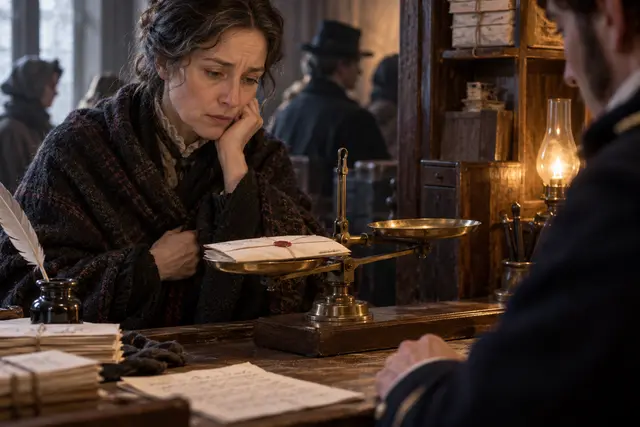
The young man at the post office had placed his letter on the scale, waiting for the trays to stop and push back the fold. He had not been unpleasant. It was almost worse. He explained that he needed thinner paper, fewer sheets, no unnecessary attachments. The letters had to leave Paris by balloon mounted; one could not send the contents of a drawer simply because a mother had finally decided to write.
He did not say that last sentence. Adèle had heard it anyway.
She walked home and squeezed her package under her shawl. In the streets, queues were now part of the landscape. We were talking about the armies, the news of the provinces, the price of what was left to eat. Adèle still had something to hold on to for a while. This small advance on hunger gave her a shame that she willingly transformed into impatience.
A few days earlier, she had sent her new address to the concierge of her old building. This was her first trip to Cécile since their break-up. She had asked to be given the information if anyone from her family came to pick her up. Not to confess what this gesture meant, she had spoken of lost mail and forgotten formalities. The concierge had not discussed the words: she had kept the ticket near her box, where a man had already presented himself without getting an answer.
On the ground floor of her house, Jeanne, the linger, wrote for the neighbors who asked for it. She didn't have a public writer's shop. She had a table, a regular hand and this way of letting people finish their sentences that was lacking to many educated people.
— "Can you copy this to me on something lighter?" asked Adèle.
Jeanne took the five leaves, then the thick envelope. A small brass key fell on the table.
— The key will not be able to leave with the rest.
— She must understand that she can come back.
— You can write it to him.
Adèle looked at the key. His daughter Cécile had returned it one evening in September, five years earlier. She was twenty-three years old and wanted to marry a man who was repairing the sets of a theater. Adèle had said that a girl choosing this life no longer needed her door. Cécile had placed the key near the plate, very gently, and had left without breaking anything. For years, Adèle had found this sweetness more insolent than anger.
Jeanne went back to the last page.
— Is the address recent?
— This is where she lived in Rouen. I kept it.
— How long?
Adèle did not answer. On the first sheet, she started with “My dear child”. Down below, she had already written three times that she was not blaming him.
What can be removed
Jeanne placed the letter near her seam.
— Read me what you want to keep.
Adèle started to stand up. On the second page, she sat down: she now heard how many times she spoke for herself. The food, her late husband, the sacrifices. Jeanne slipped her needle and did not interrupt it.
— "This passage is necessary," said Adèle, when she arrived in Anselm's name.
— Which one?
— On his acquaintances.
Jeanne waited. Outside, a wheelbarrow gnashed in the courtyard.
— “I don’t know them,” Adèle admitted. Not anymore.
She flipped the page. Under her fingers appeared the question she had come to send: how was Cécile? It took four leaves to get there.
— Start there.
Jeanne chose a paper through which the wood of the table could be seen.
— What about her husband?
Adèle hesitated, then dictated the name of Anselme. She didn’t know if they were still living together. To learn this, one should at least bear to ask the question.
A knock was made at the door. Jeanne went to open. A man in his thirties, with a hollowed-out face and a toolbox in his hand, asked if he was living here with a Madame Vallin.
Adèle first recognized his voice. He had a way of going back to the end of the sentence, as if he was leaving you a walk to answer.
Anselm went in, took off his cap, and saw the letter on the table.
— “I’ve been looking for you for three days,” he said.
He showed Adèle's little note. The concierge had given it to him during his second visit. He had not arrived there by miracle: Adèle had finally left a way to her door, and someone had taken him.
Adèle got up so quickly that the key slipped from her knees.
— Where's my daughter?
The man who stayed in Paris
Anselm did not reply immediately. He fixed the fallen key, then picked it up without holding it out to Adèle. This tiny gesture frightened him more than his silence.
He had been working in Paris since the summer. Before the city was shut up, he had sent his son to his sister in Evreux. He himself had stayed to finish a repair that had to pay him several debts. Events had cut the road faster than his hesitations.
— "Your son?" repeated Adèle.
— Baptiste Baptiste. He's four years old.
She sat down. The years were reorganizing in front of her with almost physical violence. A child had learned to walk, talk, ask for bread while she kept a key in a drawer to prove that she had not thrown it away.
— What about Cécile?
Anselm placed the key on the table.
— She died in the spring of last year.
The small room did not change. Jeanne was still holding her pen. A neighbor called someone in the yard. On the pan, a saucepan let out a damp breath. Adèle thought absurdly that we should have taken something out of the world to tell her that, to turn off a lamp, to stop a clock.
— You did not warn me.
— "I have written.
— "I did not receive anything.
— - Twice. At your old address.
Adèle had left the apartment after the death of her husband in the summer of 1868. She had instructed a former neighbor to keep the mail, then stopped passing, wounded to find nothing. However, she remembered a note asking where to send her some letters. She had not responded immediately. Then the ticket disappeared under other papers. She had long preferred to call it an oblivion.
Anselm explained the disease without giving it a detailed account. Cécile was weakened for several weeks. He had called a doctor, hoped, borrowed. Then he had to learn to answer the little boy who asked why his mother did not return.
— Why did you come now?
He opened his jacket. In an inner pocket was a worn fold, surrounded by a washed blue ribbon.
— Because she had entrusted me with this. And I didn't do everything I needed to give it back to you.
The letter that remained
Adèle recognized Cécile's writing before recognizing the words. His daughter always tilted the top of the letters to the right, then seemed to pick up again at the last moment. As a child, he was blamed for this impatient writing. Adèle had forgotten how much she loved him.
The letter was dated March 1869. The envelope was not stamped or postmarked. Adèle set it aside to open the pages; Anselm took it and slipped it under his cap. Cécile talked about Baptiste, who hid his spoons behind the curtain, Anselme, who had made him a small table too solid to be moved, and the garden they saw from their window. She did not describe a life without difficulties. She said that she had lived happily ever since.
Then came a sentence that Adèle had to reread: she did not want her mother to come to decide for them what they should have done.
It was not a request for forgiveness. It was also not a pardon granted in advance. Cécile wrote that she would have liked to see her again, but that we would have to speak differently. She asked that Anselm not be treated as a fault which she would have had to justify.
In the end, she explained that Baptiste was unaware of her grandmother’s existence. She couldn’t find the words to tell a child that a door could close without being locked.
Adèle folded the sheet. She had hoped, during the first lines, for a girl who would allow her not to be entirely wrong. She had just found the true Cecilia, capable of love and refusal in the same sentence.
— "Why did you keep it?" she asked Anselme.
He replied that he was afraid. After his two letters remained unanswered, he had believed Adèle resolved not to know anything. He had not wanted to deliver these last pages to someone who might read them to confirm an old opinion. Later, he also used this reason to postpone a difficult gesture until tomorrow.
— “I am not asking you to find it well,” he said.
Adèle heard the work necessary to pronounce such a simple sentence. She would have liked to be able to respond immediately with the same clarity. Instead, she asked if Baptiste looked like his mother.
— When he is upset, a lot.
A brief laugh escaped Jeanne. She held him back, and then realized it was too late. To his own surprise, Adèle did not resent him.
Adèle then asked if Cécile had spoken of her during her illness. Anselm turned away her eyes, and at first she thought he was hiding one last request, a word too painful to convey. She insisted.
— “Not in the way you expect,” he replied. She especially asked what Baptiste was doing in the next room. She was worried when she could no longer hear him.
Adèle felt the reproach come to her lips, as if this man had refused to give her the place that belonged to him in the last days of his daughter.
— She had a life, he added. She hasn't spent all these years waiting for you.
Jeanne had stopped sewing. Adèle wanted to ask him something, anything that forces this man to wait before speaking again. Then she looked at the page where Cécile was telling the spoons hidden behind the curtain.
— Did she find them? she asked.
Anselm followed his finger on the letter.
— Not all of them. Once, we ate the soup in turn.
He had a smile that he wasn’t addressing. Adèle lowered her eyes to leave him.
A room waiting for no one
Anselm returned the next day with some objects from Cécile. He had kept them in the trunk he had brought to Paris: a dice, a notebook of songs, a piece of fabric of which she wanted to make a collar. There is nothing to restore a person. All that was enough to make his absence precise.
Adèle led him up the stairs to his apartment. She bought some food to share. Seeing her lay out three cutlery, he asked who would come.
— - Jeanne. She received us yesterday.
He seemed relieved. Adèle understood that he feared a conversation of which she alone would choose the beginning and the end.
During the meal, she asked him about Baptiste, then about his sister Hélène, who was looking after the child. She learned that he loved horses but was afraid of chickens, that he said "tomorrow morning" for everything that had not yet happened, that he slept better when a chair touched the bed.
— "He may have the back chamber," said Adèle.
Anselm laid down her spoon.
— He lives with me.
— I was talking about later. When we can get him to come.
— You speak as if you are going to decide.
The meal froze. Adèle felt her old argument: she had more room, some savings, a house held. It could offer the child what a father forced to run the work could not guarantee. For a second, she was reasonable.
Then she saw Jeanne lower her eyes towards her plate. This glance gave her Cecilia’s voice, the door without a lock, the conditions she posed by calling it love.
— "You are right," she said with difficulty. I spoke too fast.
Anselm did not reward her with great relaxation. He resumed his spoon. It seemed unfair to her, then she understood that a new sentence could not erase all those that had preceded her.
After the meal, Jeanne proposed to put a letter to Hélène. It required a present address, certain, and news that could be read to Baptiste without asking him to settle the affairs of adults.
Adèle brought her first letter. The five leaves now began with a greeting to a dead woman and contained everything she had not managed to tell her alive.
— “This one won’t leave,” she said.
She put it in her daughter's drawer.
The address of Évreux
The new letter could not be written more easily. Adèle wanted to tell Baptiste that he had a grandmother who loved him forever. Anselm looked up.
— You didn’t know it existed.
— That's not what I meant.
— It is better to write something else.
Jeanne kept her pen above the paper. She wouldn't arbitrate. She was waiting for a sentence to really belong to those who were going to sign it.
They began with the news of Anselm. He was fine, working when he could, thinking of his son every day. He didn’t know when he could come back and didn’t promise a date. He asked Hélène if the child had kept his cough, knowing that an answer could take a long time or not find the way.
Then Adèle dictated her name and simply explained that she was Cécile's mother. She would like to know Baptiste when the circumstances would allow it, if her father wanted it too. She proposed a memory of her mother as a child: Cécile refused to eat the cherries whose tail had been detached, because she claimed that they had been torn too brutally from the tree.
— "She never said that," said Anselme.
Adèle feared an accusation, but he smiled.
He added that Cécile had retained this habit of defending small things against large hands. By contrast, she had eaten tailless cherries in all the years he had known her. They laughed at this contradiction, briefly, without obliging themselves to prolong the moment.
Adèle wanted to join the blue ribbon. She put it on the sheet. Anselm stopped him.
— - Keep it. We'll tell you what he tied up. The child does not need to receive everything at once.
She first thought of the weight of the fold, and then realized that it was talking about another weight.
Finally, they asked Helen to read the passages intended for Baptiste, without yet giving him his mother’s letter. It should be discussed with him, in a time that would be neither that of urgency nor that of curiosity of adults.
Jeanne reread the set. There was plenty of room for Adèle's signature, big, clumsy. She had not written her name so carefully since her marriage.
The wind does not sign a receipt
At the post office, Adèle presented the new fold with disproportionate concern. The paper was thin, the key had remained at home, the ribbon too. Yet she looked at the scale as if it could still uncover some hidden reproach between the lines.
This time the letter was accepted. It bore his postage and the mention indicating the carriage by mounted balloon. The employee promised neither the day of departure nor the day of arrival. The winds did not obey the impatience of the shippers and a balloon did not follow a street to the right door.
— "Evreux is not so far away," said Adèle.
The man looked at her without answering. She remembered all the distances she had created inside the same apartment.
When she got out, she found Anselme near the wall. He let her do the walk alone. It was not a test he imposed on her. She had asked to do so, and he thought she was able to keep her request.
They walked to the Seine. It was cold. A cart passed, shaking its empty boards. Adèle asked if the pigeons really reported the news from the province. Anselm had heard of it, too. He only knew that one should not expect from a difficult sky what was once required of a postman on the corner of the street.
— “We can send another letter,” he said. Even if we have not received a reply.
The idea surprised her. For five years, she had considered every silence as an argument to keep her own. She had never imagined that one could write again without being sure of having been heard.
When they returned, Jeanne was waiting on the stairs, a packet of linen on her arm. Her younger brother had left with a unit, and she had no recent news. Adèle realized that she had made him copy several pages about his own pain without ever asking her the question.
She finally put it down. Jeanne answered little, but sat down.
That night, no one got the answer they wanted. They ate a fairly clear soup, repeated some times to make, talked about the lamp that was drawing badly. Adèle, for once, did not try to turn this poverty of news into proof that nothing served any purpose.
Days without an envelope
December is coming. Adèle watched the steps on the stairs with an avidity that humiliated her. Every paper intended for a neighbor seemed to him a personal mistake. Anselm continued to look for work. When he won something, he set aside a share for the return, and Adèle refrained from commenting on the amount.
They wrote even more briefly. A first balloon might not have taken their letter, or dropped it off far from its destination. They didn’t know about the trip. They did not try to invent a reassuring route.
One day, Adèle asked if Anselm could fix the lock in the back room. He hesitated.
— For whom?
— “For the tenant whom Jeanne knows. A seamstress is looking to share a home. She could pay a little bit and help us heat the occupied rooms.
He looked at her longer than she expected.
— Aren't you waiting for Baptiste anymore?
— - Yes. But I don't want to prepare a room that looks like him until I've met him.
The phrase cost him. She had been looking at this room for weeks imagining a grateful child coming in. Now he had to accept that he could prefer a less beautiful bed with his father.
The dressmaker's name was Philomena. She talked a lot, coughed at night, and had a tiny box where she would put buttons in families rather than colors. His arrival does not repair any old relationship. She only made the house less silent, and Adèle discovered that this unexpected presence helped her more than a perfectly ordered wait.
Towards the end of the month, Anselm brought him a sheet covered with dates. He had reconstructed for her the years of Cecilia: their marriage, their changes of housing, the birth of Baptiste, illness. He had left white people when he couldn't remember.
— “I can tell you,” he said. But not all of it tonight.
Adèle placed the sheet near the lamp.
— Not all of it tonight.
They first spoke of a walk in Rouen where Cécile had lost a shoe in the mud. A story without importance, without a last word, without a sign announcing the end. Adèle understood how many such stories she lacked.
The Answer Arrived Late
Hélène's letter reached them after the siege was over. It had been written for several weeks and bore the traces of a journey that they could not fully reconstruct. Adèle held it without opening it until Anselme returned. The first name on the fold was his.
Baptiste was better. His cough had stopped; he slept again without waking up the whole house. He had listened seriously to the history of cherries, and then asked if his grandmother knew how to repair the wheels of his cart. Hélène added that she still did not know how to prepare for their meeting. It would not be enough to appoint a person to make a place for him.
A second sheet carried a line guided by his hand: "Daddy, come back when you can." Further down, Baptiste had traced what he called a horse. Anselm followed the legs with the fingertip without touching the ink. He announced that he would seek out how to leave the next day.
Adèle agreed. She would have liked to ask 20 questions. She chose one: did she need money for the trip?
— "Perhaps," he said. I'll tell you.
He folded the drawing, then returned to the end of Helen's letter. Adèle saw him stop. He read the few lines a second time and put the sheet under the first.
— “She’s talking about Cécile?” she asked.
— - Yeah.
He kept his hands on the table. After a while, he handed her the page.
Hélène had written that she was happy to know finally delivered the letter of March. She had seen Cécile prepare her, a few weeks before her illness. Her sister-in-law had even bought a hat: she wanted to be ready if her mother announced her coming. A small gray hat, which they had found too expensive and which she had taken anyway.
Then came a sentence underlined by the fold of the paper: “She believed that you had carried her during your visit to Paris.”
Adèle laid the letter flat.
— Have you come?
Anselm did not answer.
— In March. Before she got sick.
— - Yeah.
The room narrowed around them. In the next room, Philomène slipped his chair to get closer to the window. Adèle heard the sound of the wood, then nothing.
— “You told me that you kept this letter after the other two remained unanswered.
— "It was after his death that I wrote you these two letters.
— "I know. You let me put things in that order.
She took Cécile's fold in the drawer. The envelope bore no postmarks. He had told her he had to hand her over; she had imagined a last duty entrusted to her by a dying woman. A girl who bought a hat did not prepare her farewell.
Anselm had brought the letter to Paris in March, before the illness. He found the old building. The concierge told her that Adèle had moved. She could ask the neighbor who still kept some papers. He stood in front of the box, with the letter in his pocket.
— “Then I left,” he said.
He had told Cécile that we would follow the fold. He did not say that he had brought it back to Rouen. She had waited for an answer. He had seen her prepare her sentences, then remove them one by one from their conversations.
— “Why?” asked Adèle.
This time, she didn’t need to raise her voice.
He looked at the envelope. Cécile had written the old address with application, much slower than in the rest of her letter.
— “I thought you would come and tell us that nothing was right. Our housing, my work, the way we raised Baptiste. I thought I was preventing him from suffering again.
— Then you made him think I wasn't answering.
He nodded.
Adèle stood up. She wanted to show him the door. The whole sentence came to him, almost intact, with this frightening facility of gestures long practiced. She leaned on the back of her chair.
Anselm lied. She had once hunted him with Cécile. These two facts did not replace each other. She couldn’t take the first one to regain five years of innocence.
— Come out for a moment, she said. I don't want to talk to you now.
He took his hat, then stopped in front of his son's drawing. Adèle pushed him towards him. He took it.
She remained standing until Jeanne came in, called by Philomena. The linger read the few lines that Adèle showed him. She did not seek any additional reason for Anselm's gesture.
— “I made room for him here,” murmured Adèle.
— - Yeah.
— And he knew it from the beginning.
Jeanne closed a chair. Adèle finally sat down.
That night, they prepared no answer. For the first time since November, the table remained covered with open letters that no one tried to lighten.
The grey hat
Anselm came back two days later. He had found a way to reach his son. He did not ask that Adèle accompany him or that she pay. He had brought the notebook where he wrote down what he owed him for the shared meals.
— “It is not this debt that interests me,” she said.
He put the notebook away.
Adèle asked for the hat. He immediately understood which one. Hélène had kept some of Cécile’s clothes; he would write to her when she arrived.
— “You can answer me directly,” she added. She and you. I no longer want to learn by chance what they decided to spare me.
— "I will.
She looked at his hands. They were cracked by the cold, with a small cut near a nail. During their first meal, she had sought out the hands of a man who had been able to hold her daughter. She had just learned that they had also withheld her letter. Some had not replaced the others.
— “Don’t make Baptist a way to ask me for forgiveness.
— I don’t ask you to do it with him.
— Then we can talk about his visit. Later.
He left with his toolbox and his son's drawing. Adèle did not give him the key. She kept the money for the trip in an envelope, and then sent it to Hélène when the address was confirmed, with a sentence stating that it could be used for the child's expenses. She didn’t ask for news in return. She waited, however, with an impatience of which she was not proud.
The weeks passed. They exchanged letters shorter than their conversations in November. Anselm answered the questions asked. Sometimes he would add a memory of Cecilia; Adèle would read it several times before finding out what she could do with it. She didn’t have to forgive me if she wanted to hear more about her daughter.
Baptiste came to Paris the following autumn. It was raining, he had slept badly and his first question was where his father was going to sit. Adèle showed him the chair by the window. The child chooses the one next door.
Philomena had placed buttons on the table, stating that they could be sorted in any way possible, except swallowing them. Baptiste announced that they would make wheels. Adèle brought a small empty box. Anselme proposed to drill the holes for the axes.
— "You must first know how many wheels," said his son.
Adèle almost answered four. She held back. Baptiste wanted six.
The toy was going wrong. While Anselme was picking up an axis, the child saw the brass key near the sewing box.
— What does it open?
— A door where your mother lived as a child.
— Can we go?
— Other people live there now.
He asked why she kept a key that no longer served. Adèle had no short answer. She put it in the drawer and returned to the cart. The boy had already chosen an extra button.
After tasting it, Anselme took out of his bag a box wrapped in paper. The gray hat rested there, a little deformed on the side. Adèle immediately recognized this tiny defect that she would have corrected before greeting her daughter.
She lifted the hat. Under the inner trim, a needle was still holding a brown thread. Cécile had started to tighten the band, then left the work in abeyance.
— "Hélène found it underneath," said Anselme.
He handed her a small piece of paper. Two columns shared it. On the left, things to buy; on the right, gestures not to forget. Rinse the blue cup. Move the table. Tell Anselm not to prepare a speech.”
At the bottom, a last point, added bias: “Ask her if she still has her coffee without sugar.”
Adèle looked for another line below, but the list stopped there. The coffee, the blue cup, the table to move. Her daughter had these gestures to prepare while she herself stored a key in her drawer.
Adèle closed her fingers on the sheet. Anselm watched her son work. He couldn’t fix it with another confession.
Adèle's first letter was still in the drawer: five pages to explain why she wasn't wrong.
His daughter had written much less.
She kept a chair for him.
End