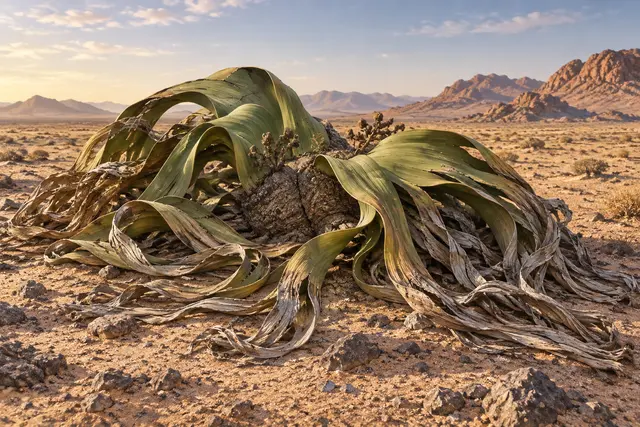
At the edge of the desert, a tangle of green and dried ribbons seems to come out of a stump. There could be a lot of leaves. At Welwitschia mirabilis, which occurs naturally in Namibia and Angola, this impression hides a much more singular organization: two large leaves continue to grow during the life of the plant.
Over time, they split into segments. Their extremities decay as their base continues to grow. What looks like foliage renewed by a number of new pieces is therefore largely the result of the division and wear of the same organs.
This plant can live for several centuries. It would, however, be misleading to take each visible ribbon for an intact sheet as old as the whole. Its longevity is accompanied precisely by growth and degradation. In this strange bouquet spread out, it is not a perfect conservation that surprises, but the persistence of a minimal architecture in the middle of the traces left by time.
What we know
Two persistent leaves do not mean two intact leaves; extreme ages are estimated.
To go to the source
References consulted on September 21, 2026. Linked pages may be in another language.
Signaler une erreur ou apporter une précision