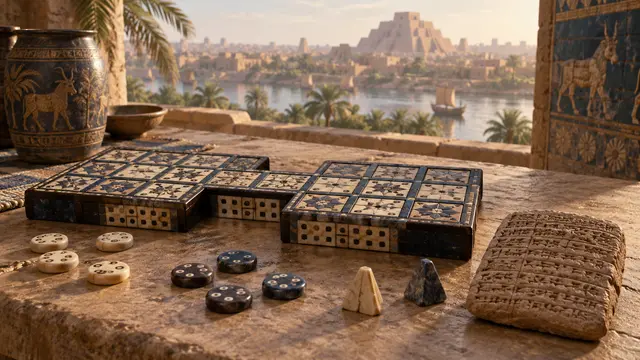
An antique board can be beautiful and remain unusable if no one knows its rules. The royal game of Ur offers a rare opportunity to overcome this frustration. Very ancient Mesopotamian plateaus have survived, but a much later document has made it possible to better understand how one played in this tradition.
A cuneiform tablet dated 177 BCE gives indications for the game of twenty squares. She contributed to the deciphering work of curator Irving Finkel. The British Museum describes a race between two players, while some squares could also be used for divinatory practices. The written object therefore reveals several uses of the plateau.
Be careful, however, with the shortcut: the tablet is not contemporary with the oldest specimens discovered in Ur. The game has evolved over the centuries. Reconstructing a playable version doesn’t mean you get back exactly every part of every era. The real pleasure remains: material traces and a text make it possible to put back pawns in motion.
What we know
Late rules; evolution of the game explicitly preserved.
To go to the source
- British Museum — tablette Rm.III.6.b (new tab)↗
- British Museum — Top 10 historical board games, jeu royal d’Ur (new tab)↗
References consulted on September 21, 2026. Linked pages may be in another language.
Signaler une erreur ou apporter une précision