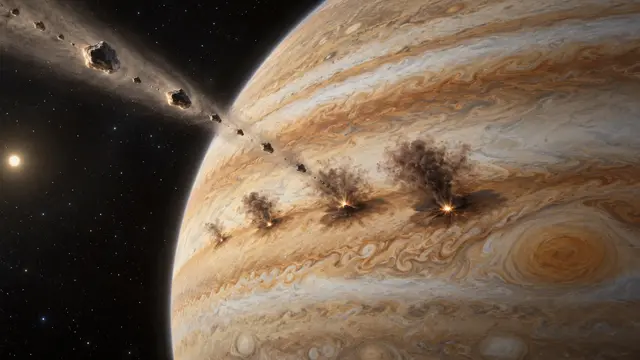
When it was discovered in 1993, the comet Shoemaker-Levy 9 was no longer a single piece. A series of fragments follows an orbit around Jupiter. Observations indicate that an earlier close passage has dislocated it under the powerful tidal forces of the planet.
The calculation of the trajectories adds a new surprise: the fragments will collide with Jupiter. Between July 16 and July 22, 1994, the impacts occurred. Galileo, still en route to the planet, enjoys a position allowing direct observations; other instruments also study the events and their aftermath.
Large dark marks appear in the atmosphere before fading under the action of the winds. These are not craters dug into solid soil. The material left at altitude even helps to track atmospheric circulation. The comet disappears, but its destruction provides a natural experiment that astronomers could never have organized: observing a planet react to a succession of impacts.
What we know
Impacts in Jupiter’s atmosphere; dark marks are not surface craters.
To go to the source
References consulted on September 21, 2026. Linked pages may be in another language.
Signaler une erreur ou apporter une précision