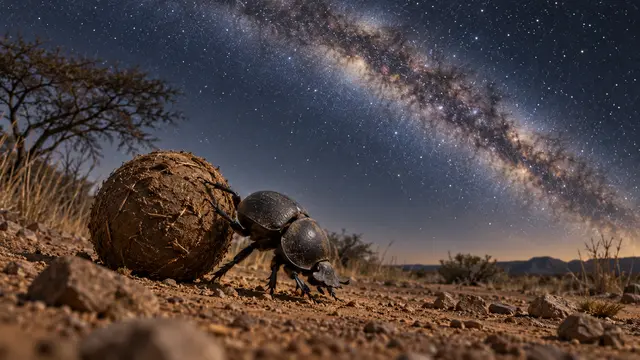
The problem of the dung beetle begins once its ball is made. Around the heap, competitors can take it from him. To move away effectively, it is better to keep one direction rather than going in circles. But how to keep this moonless course, when terrestrial landmarks are difficult to distinguish?
Researchers have observed that African dung beetles continue to roll straight under a starry sky, but lose this ability when clouds hide it. They then placed the insects in a planetarium. Surprise: The Milky Way’s single light strip was enough to provide them with a useful marker, even without all the individual stars.
The beetle therefore does not consult a map of the constellations to find an address. The light of the sky helps him maintain his flight path. The experiment thus links a tiny task, taking a little food, to a gigantic structure: our galaxy becomes a landmark of displacement for an insect on the ground.
What we know
Maintaining a course does not mean knowing a destination.
To go to the source
References consulted on September 21, 2026. Linked pages may be in another language.
Signaler une erreur ou apporter une précision