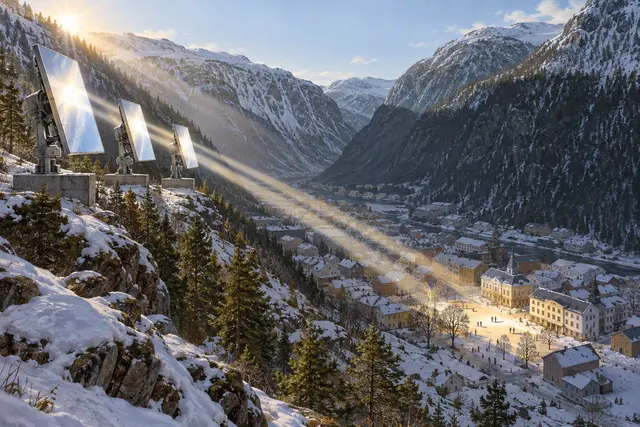
In winter, the bottom of the Rjukan valley remains in the shadow of the mountains. The Norwegian city is not immersed in a permanent polar night: it is the relief that prevents direct rays from reaching certain places. While the sky can be bright, the place awaits its sun.
In 2013, three computer-controlled mirrors were put into service on the slope. They follow the solar position and send the light back to the city square. The project, taken over by Martin Andersen, realized an idea envisaged as early as 1913, but long remained without a practical solution.
Mirrors do not illuminate all streets and obviously do not move the mountain. They create a space where locals can enjoy the direct sun when the relief would normally have hidden it. We had to look over the city to find an answer to what was missing at the bottom: the light was present, simply located on the wrong side of the shadow.
What we know
Shadow related to the relief; three mirrors inaugurated in 2013, limited lighting of the place.
To go to the source
References consulted on 3 October 2026. Linked pages may be in another language.
Signaler une erreur ou apporter une précision