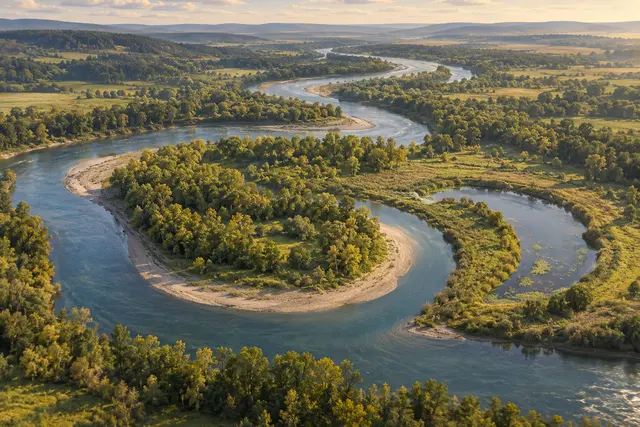
Seen from above, a meandering river can return very close to a place it has just run along. It does not necessarily go up its course: its bed draws curves that lengthen the path with respect to a straight line.
The National Park Service explains that erosion acts on the outside of the curves, while materials are deposited more inside. The meanders can thus move gradually. When two parts of the route meet, the water can take a shortcut and leave a loop.
The old passage can become an isolated arm, then a crescent lake that fills with time. The map sometimes keeps the shape of a river that the water has already left. History therefore requires no magical change of meaning or river crossing the exact same point twice: the landscape bears the traces of its own revisions.
What we know
Meandering and cross-checking; no confusion with a truly reversed current, already dealt with in another notice.
To go to the source
References consulted on September 21, 2026. Linked pages may be in another language.
Signaler une erreur ou apporter une précision