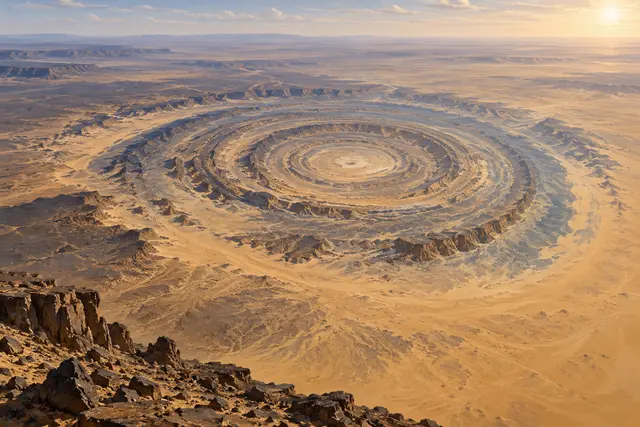
Seen from space, the Richat resembles a target drawn in the Mauritanian desert. Its concentric ridges easily evoke the trace of an impact. This resemblance has indeed fed a first interpretation of the formation.
The geological work led to another explanation: a dome of rocks raised, then deeply eroded. Not all materials are resistant in the same way. Their differentiated wear helps to reveal the circular reliefs that satellite images make so readable.
The immense motive therefore does not need a shock from heaven to exist. It is the result of Earth's transformations and their long exposure. The most misleading is its sharpness: an image can make an immediately recognizable form without immediately revealing the story that produced it.
What we know
The nickname “Eye of the Sahara” describes an appearance. The 2026 scientific record has a geological origin, not an impact crater.
To go to the source
References consulted on September 20, 2026. Linked pages may be in another language.
Signaler une erreur ou apporter une précision