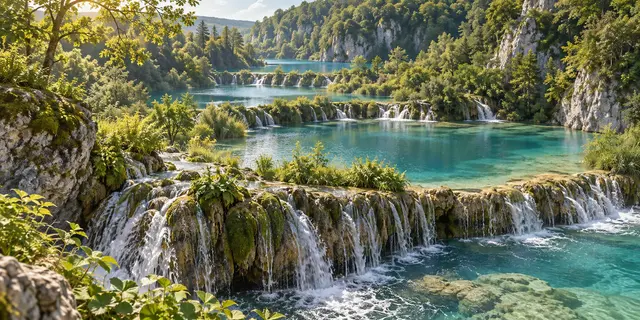
In Plitvice, Croatia, the lakes seem to be arranged like the floors of a garden. However, their separations are not concrete. They are formed by accumulation of calcium carbonate transported in water, combining geology, chemistry and living organisms.
Mosses, algae and some bacteria participate in the formation of limestone tuff, also called travertine in the UNESCO presentation. Deposits build obstacles that hold water and organize basins. The living does not act as a team with plans: it intervenes in physical and biological conditions favorable to this accumulation.
The landscape then continues to evolve. Barriers grow, erode, and alter flows; water quality matters to the organisms that contribute to the process. The view we admire is therefore not a finished set once and for all. It is a stage of a natural construction site whose most discreet partners are often those that the photograph does not show.
What we know
Process cooperation, with no intention of building attributed to microorganisms.
To go to the source
References consulted on September 21, 2026. Linked pages may be in another language.
Signaler une erreur ou apporter une précision