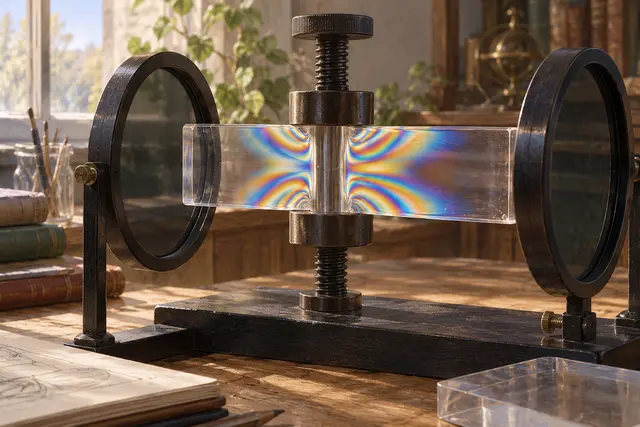
A transparent piece of plastic can look perfectly uniform. Yet, placed in a device using polarized light, it sometimes reveals colored bands. The material did not receive any additional pigment. The pattern depends on how it transforms the light that passes through it, especially under mechanical constraints.
The Exploratorium exhibits this effect with a transparent model under pressure. Constraints change the organization of the material and its optical behavior. Polarizing filters make it possible to translate these differences into colors. Not all regions respond in the same way: the pattern reveals a distribution of constraints rather than a simple uniform coloring of the room.
A clear appearance does not guarantee a tension-free structure. The drawing can evolve with the applied load and with the observation configuration. One cannot universally assign a precise force to each color without taking into account the mounting. The interest remains: the light makes perceptible something that transparency seemed precisely to hide.
What we know
Color alone does not give a universal measure of strength.
To go to the source
References consulted on September 21, 2026. Linked pages may be in another language.
Signaler une erreur ou apporter une précision