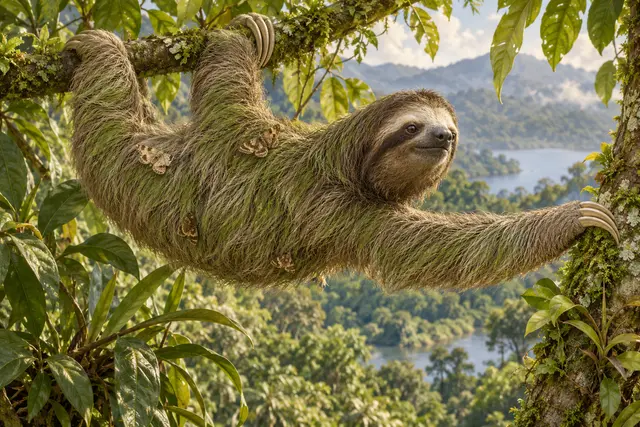
A three-fingered sloth changes branches with passengers. Its coat can accommodate algae and small butterflies. Cracks in the hair retain moisture, providing a favorable environment for algae. Behind a motionless appearance there exists a set of organisms whose cycles intersect.
A team working in Costa Rica studied these relationships. Adult butterflies live in the fur, while their larvae grow in the feces of the ground sloth. Animals with more butterflies also had more nitrogen-rich coats and more algae. These associations led the researchers to propose nutrient exchanges.
However, it would be excessive to say that the lazy person consciously cultivates a vegetable garden on his back. The exact dietary contribution of algae and how they are ingested remain discussed. The study draws an ecological hypothesis, not an animal intention. What appears to be a simple fur is already, on a small scale, a shared habitat.
What we know
The proposed nutrient benefit does not demonstrate any intentional cultivation.
To go to the source
References consulted on September 21, 2026. Linked pages may be in another language.
Signaler une erreur ou apporter une précision