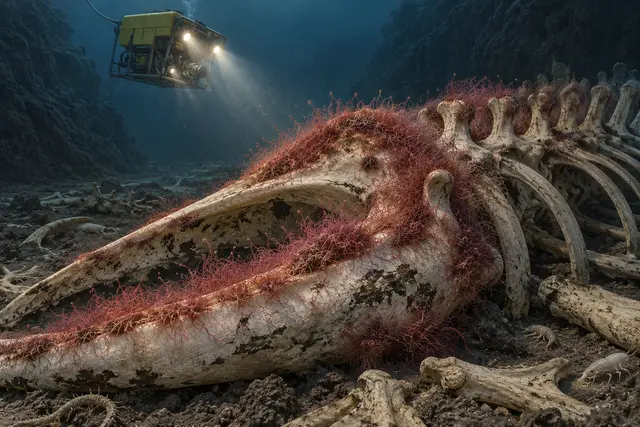
In February 2002, a team explored the Monterey Canyon with the underwater robot Tiburon. She expects to find shells. The images instead show a dead whale whose bones carry a kind of red carpet. The filaments belong to worms unknown to researchers.
These animals will be classified into a new genus, Osedax, described in 2004. Females have no mouth or digestive tract. Root-like tissues penetrate the bone, where they help make nutrients accessible. Bacteria associated with these tissues participate in this singular life.
The skeleton is therefore not only the last trace of a whale: it becomes a medium and a resource for other organisms. The carpet seen from the ship signaled an ongoing transformation. Where the researchers thought they would encounter an ordinary seabed, they had discovered a community capable of pursuing a meal into the bones.
What we know
Discovered in 2002, description of the genus in 2004; mouthless feeding in females described.
To go to the source
References consulted on 3 October 2026. Linked pages may be in another language.
Signaler une erreur ou apporter une précision