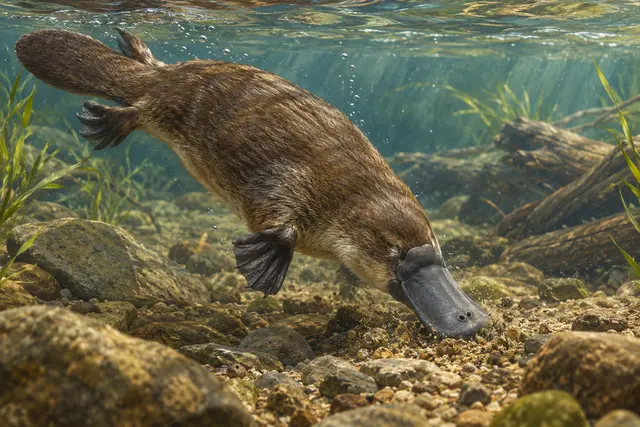
When the platypus seeks food under water, it closes its eyes, ears and nostrils. This combination might seem catastrophic to a hunter. Still, he continues to find small animals at the bottom of the streams. Its beak, often compared to that of a duck for its shape, has very different sensory abilities.
It carries receivers sensitive to pressures, but also to electric fields. Experiments have shown that the animal can locate or avoid objects thanks to such fields. The weak signals associated with the muscle activity of prey are potentially useful information, in addition to the mechanical disturbances that their movements produce in the water.
Captured prey can be kept in the abajoues, and then chewed when the platypus returns to the surface. The hunt is not based on miraculous vision in the dark. It uses other sensory equipment. The precise way in which electrical and mechanical information combine remains more complex than a simple detector that would automatically indicate each meal.
What we know
Electroreception complements other sensory information from the beak.
To go to the source
- Australian Museum — Platypus (new tab)↗
- Scheich et collègues — Nature, 1986, résumé PubMed (new tab)↗
References consulted on September 21, 2026. Linked pages may be in another language.
Signaler une erreur ou apporter une précision