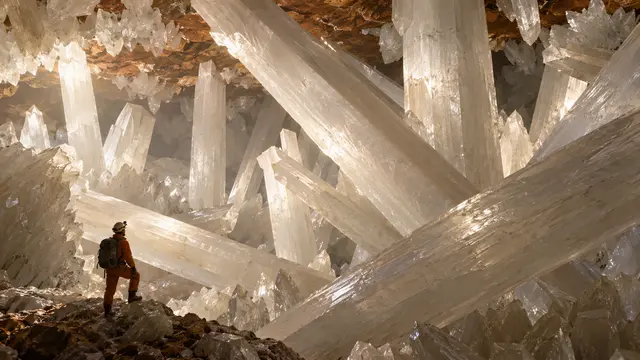
Miners discovered in 2000 a cavity filled with gigantic gypsum crystals, under Naica. Some reach several meters in length. Their size could suggest a particularly fast crystallization. However, research leads in the other direction: this landscape is the result of conditions that allow for extremely slow growth.
The cave was filled with hot water. At a temperature slightly below about fifty-eight degrees, the anhydrite could dissolve while the gypsum crystallized. Dissolution thus supplied the solution with constituents necessary for growth. A lasting balance of temperature and composition has allowed some crystals to acquire exceptional dimensions.
Scientists have studied these mechanisms and measured very low growth rates. This does not give an exact and identical age to each crystal: conditions have a history. The astonishment comes above all from the contrast between the final object and the process: to make a giant, nature was able to advance at an almost imperceptible slowness.
What we know
The exact age of the crystals not deduced from a single velocity.
To go to the source
- Gázquez et al., 2016 — The Caves of Naica: a decade of research (new tab)↗
- Entretien avec Juan Manuel García Ruiz — Université de Grenade (new tab)↗
References consulted on September 21, 2026. Linked pages may be in another language.
Signaler une erreur ou apporter une précision