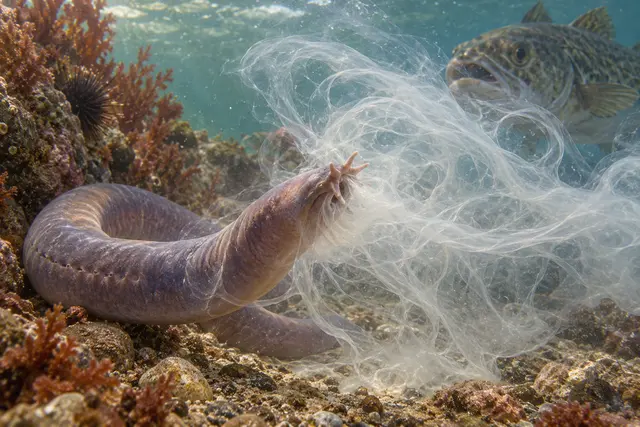
The defense of myxin becomes spectacular when it meets seawater. Secretions from its glands are deployed in a viscous material capable of hindering a predator. However, this mixture contains very little material produced by the animal. Much of its volume corresponds to the surrounding water retained in its structure.
To understand this efficacy, researchers studied its constituents separately. The mixture combines mucins, involved in viscosity, with long protein fibers that contribute strongly to its elasticity. Their study describes an operation close to a very thin sieve: the water is held between wires covered with mucus, rather than in a simple homogeneous block.
This architecture is compatible with a defense against predators breathing through gills, where the passage of water is essential. It does not mean that every opponent would be killed. The astonishment comes from the material: a few components released in the right place are enough to transform the available water into a temporary obstacle.
What we know
The study of the material does not demonstrate the systematic death of predators.
To go to the source
References consulted on September 21, 2026. Linked pages may be in another language.
Signaler une erreur ou apporter une précision