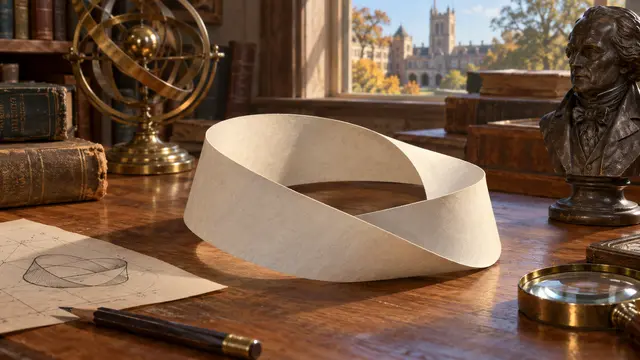
A strip of paper closed in ordinary ring has an interior and an exterior. But if we give a half-turn at one end before connecting it to the other, we get a ribbon of Mbius. This minimal difference however modifies a fundamental property of the surface represented.
By following the ribbon without crossing its edge, we reach what seemed to be its other side. A line can go through the parts corresponding to the front and back of the initial strip before returning to its starting point. The mathematical surface has only one face: the opposition between inside and outside no longer works as in the ordinary ring.
The University of Wisconsin Museum of Physics presents this discovery as an entry into topology. Mbius and Johann Benedict Listing independently studied this surface. The real paper obviously keeps a thickness; it serves as a tangible model. With a discreet twist, a mundane object allows to explore a geometry that our visual habits anticipate very badly.
What we know
The single face refers to the mathematical surface modeled by the paper.
To go to the source
References consulted on September 21, 2026. Linked pages may be in another language.
Signaler une erreur ou apporter une précision