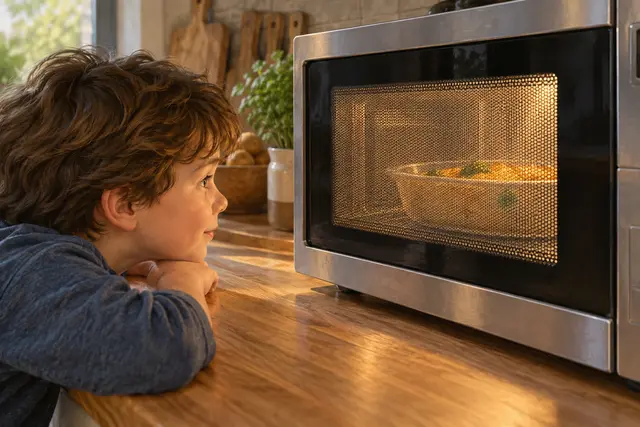
The door of a microwave effectively retains the waves used to heat, while allowing you to watch the food. Behind the glass is usually a metal grid with small holes. Its role depends mainly on the relationship between the size of these openings and the wavelengths concerned.
At the current frequency of 2.45 gigahertz, the wavelength is about 12 centimeters. The holes in the grid are much smaller. This conductive screen is therefore an effective obstacle to microwaves. Visible light has much shorter wavelengths and can pass through the openings, allowing our gaze to reach the inside of the oven.
Glass alone would not explain this difference: microwaves can pass through glass. The grid makes a selection related to the properties of the waves and the conductor, without acting like a sieve of small balls. Seeing through a door does not mean that it is also transparent to all parts of the electromagnetic spectrum.
What we know
The effect depends on the dimensions and the conductive nature of the grid.
To go to the source
References consulted on September 21, 2026. Linked pages may be in another language.
Signaler une erreur ou apporter une précision