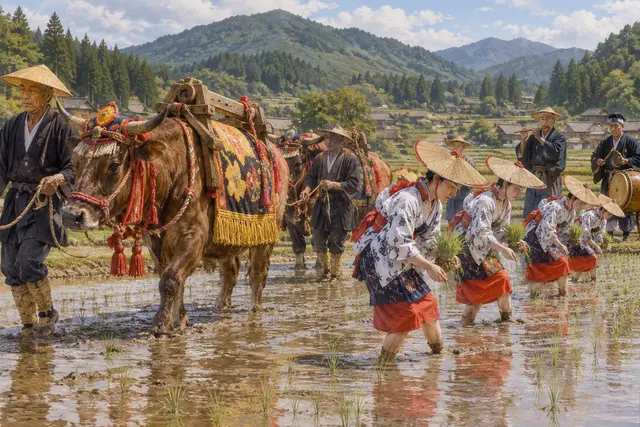
On the first Sunday of June, in communities in Kitahiroshima, Japan, a field is reserved for a particular plantation. The real agricultural work is already finished, but the Mibu no Hana Taue takes the steps in ritual form to honor the deity of rice.
Cattle wear colorful saddles and ornaments before reaching the field. After their passage, participants transplant the young plants by walking backwards, to the rhythm of songs accompanied by drums, flutes and small gongs. Elders lead the ceremony.
The ritual expresses the wish for an abundant harvest, without being proof that it provokes it. It also preserves songs and a collective organization related to rice cultivation. The calendar creates an astonishing duplication: after having performed the useful gestures in the fields, they are replayed to give them a community dimension.
What we know
Ritual after actual plantings; effect on crops of faith.
To go to the source
References consulted on 3 October 2026. Linked pages may be in another language.
Signaler une erreur ou apporter une précision