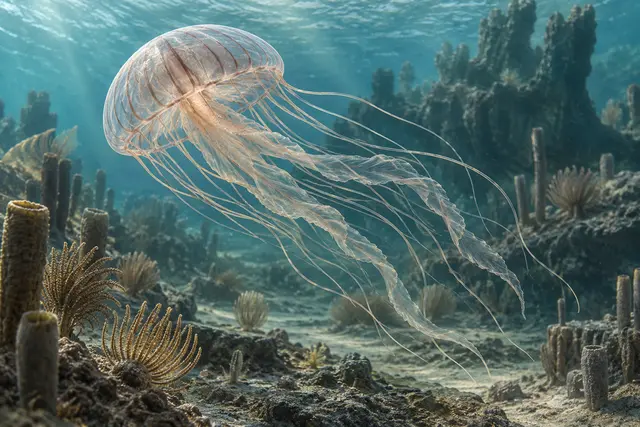
A jellyfish seems ill-equipped to leave a fossil: its soft body does not have the skeleton that is spontaneously imagined in a paleontology showcase. However, exceptional conditions can preserve this type of animal.
In 2023, the Royal Ontario Museum presented Burgessomedusa phasmiformis, a free-swimming jellyfish from the Burgess Shale, about 505 million years old. The fossils make it possible to identify a free-swimming jellyfish form in Cambrian ecosystems.
This age does not mean that the current jellyfish have remained the same since that time. The fossil documents an ancient form and illuminates the diversity of marine life. What water now makes transparent and fugitive can thus become, in the rock, a lasting witness of a world long before the landscapes associated with dinosaurs.
What we know
Approximate age of the fossil; no immortality of an individual or lack of evolution of the current jellyfish.
To go to the source
References consulted on September 21, 2026. Linked pages may be in another language.
Signaler une erreur ou apporter une précision