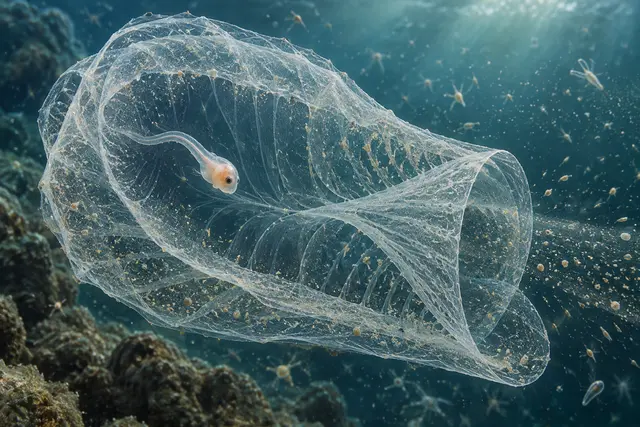
A giant teardrop looks tiny next to the translucent structure that surrounds it. This “house” is not a shelter of stone or algae: it is made of mucus. Its filtering networks intercept particles present in the water that the animal sets in motion with its tail.
The device is difficult to study. By lifting it up or placing it in a container, we risk distorting what we want to understand. At the MBARI, Kakani Katija and her colleagues developed observations using a laser tablecloth to track the flow around animals in their environment.
These images reveal the workings of a structure that filters and concentrates food without looking like a human-made device. The word “house” can therefore be misleading if one only imagines a refuge. Here, housing is also a part of the meal: a set of passages that organizes water, retains useful particles and makes a fragile material a tool for survival.
What we know
The houses are mucus filtering structures; narrative of the works described in 2017, without generalization to all planktonic animals.
To go to the source
References consulted on 3 October 2026. Linked pages may be in another language.
Signaler une erreur ou apporter une précision