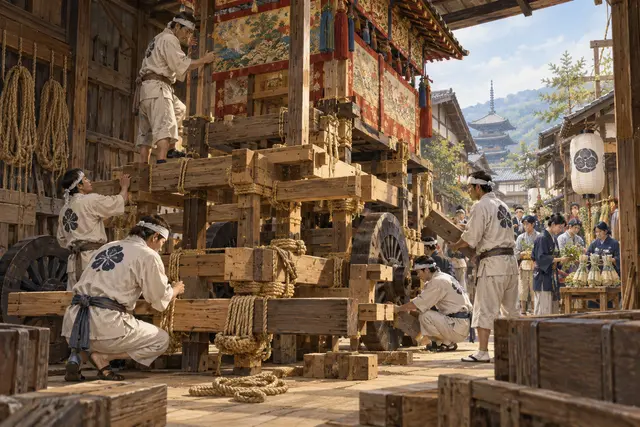
Before joining the procession, Ashikari-yama’s tank had to break out of its warehouse. In Kyoto, his conservation foundation describes an assembly made by carpenters using ropes, without nails. The spectacular object that the public then discovers is therefore also the result of a reconstruction and a precisely shared knowledge.
The preparation engages the neighborhood beyond the artisans alone. The locals make chemaki, protective objects according to the local belief, and prepare the reception of the party. Responsibilities also include the decoration of the community space used for the occasion. These tasks connect the July parade with much less visible meetings and gestures.
The Ashikari-yama program provides for assembly before its July 17 procession. But each Gion Matsuri tank has its peculiarities: this example does not describe all the identical neighborhoods. Continuity is based on the maintenance, organization and participants of today, as much as on the conservation of ancient elements between two successive festivals.
What we know
Example of Ashikari-yama; variable programs.
To go to the source
References consulted on September 21, 2026. Linked pages may be in another language.
Signaler une erreur ou apporter une précision