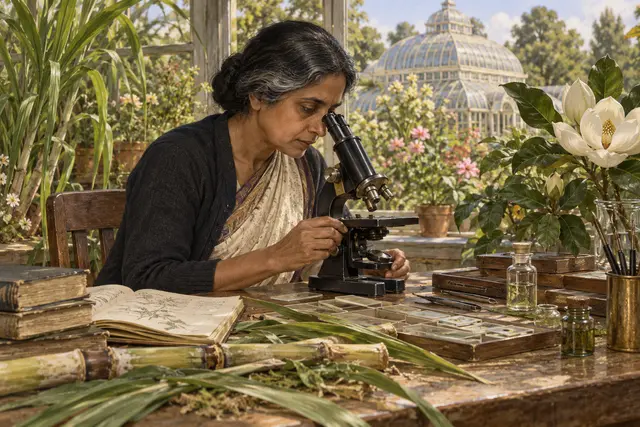
A plant can change its appearance because something invisible to the naked eye has changed in its cells. Janaki Ammal explores this possibility by studying the chromosomes of plants. His work connects the microscope to the garden: the differences observed in the cells may accompany differences in growth, leaves or flowers.
After her research on sugar cane in India, she studied many horticultural plants in England. With Cyril Darlington, she published in 1945 an atlas of chromosomes of cultivated plants. She then joined the Royal Horticultural Society, where her research focused on plants with four sets of chromosomes instead of two.
Wisley’s archives hold specimens she has prepared, and a magnolia bears her name. Chromosomes are not a recipe for a better plant in all respects. However, they offer a remarkable entry into plant diversity: to understand a garden, this botanist also observed the intimate organization of her cells.
What we know
Multiplying the sets of chromosomes does not guarantee all the desired characters.
To go to the source
References consulted on September 21, 2026. Linked pages may be in another language.
Signaler une erreur ou apporter une précision