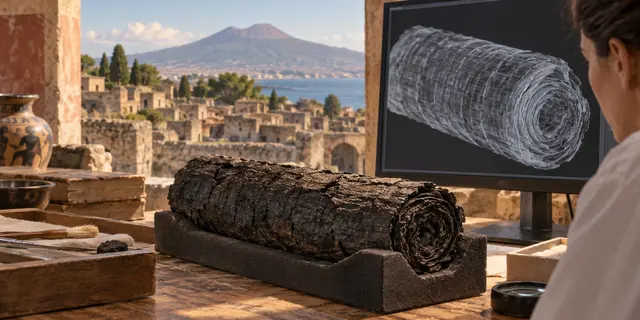
A charred scroll can retain a text while preventing it from being read. Opening it physically can destroy the fragile layers of papyrus. This is the problem posed by Herculaneum manuscripts, buried during the eruption of Vesuvius in 79. Researchers have been working on a reading that leaves the scroll closed.
X-ray images describe its internal structure. Software tracks the surfaces of the papyrus, while machine learning methods help spot the writing. The Vesuvius Challenge has accelerated this work: in 2023, a Greek word relating to purple was identified in the data of a scroll still closed.
The result is not a story invented to fill the blanks. Ancient text specialists examine the recovered characters for reading and interpretation. This first step was not equivalent to translating all the preserved rolls. It showed something essential: a materially inaccessible library could begin to read again, without unrolling the objects.
What we know
Story centered on the stage of 2023; subsequent readings not summarized.
To go to the source
References consulted on September 21, 2026. Linked pages may be in another language.
Signaler une erreur ou apporter une précision