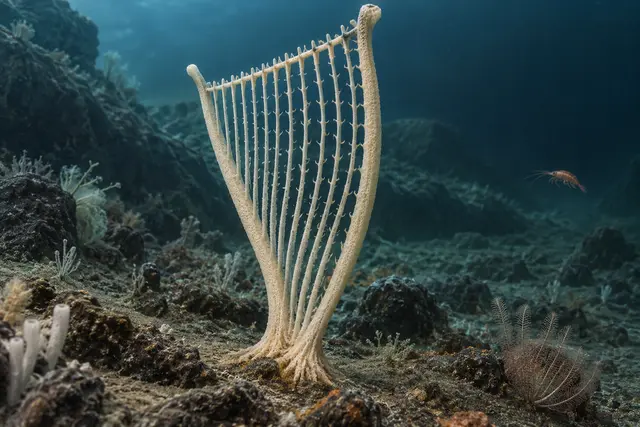
The branches of Chondrocladia lyra draw a silhouette that evokes a harp. This sponge, described in 2012 from explorations off the coast of California, does not just filter tiny particles in the water. It can capture small crustaceans.
Along its vertical branches, small hooks hold the prey. The elegant structure is thus a hunting device adapted to an environment where food resources are scarce. The sponge remains fixed at the bottom: it does not continue its meal, but increases the possibilities of encounter with what passes within reach.
Carnivore remains exceptional among sponges, and this species is not the first in which it has been discovered. Its name, however, recalls a striking contrast: the shape that resembles a delicate instrument is that which allows a motionless animal to take prey larger than the particles usually filtered by its cousins.
What we know
Carnivore sponge; not the first discovery of carnivore in this group.
To go to the source
References consulted on 3 October 2026. Linked pages may be in another language.
Signaler une erreur ou apporter une précision