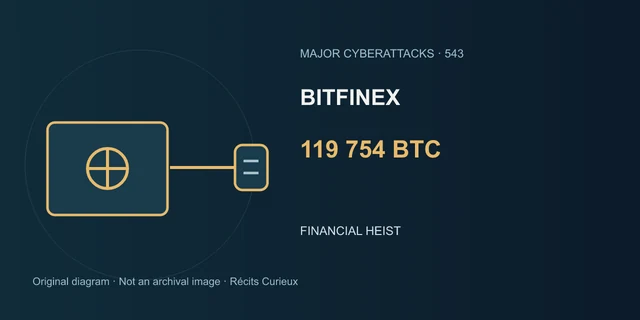
In August 2016, Bitfinex suffered a theft of 119,754 bitcoins. Their value as of that date is tens of millions of dollars. Years later, the same units are worth billions. Confusing these two assessments would turn the narrative of the theft into a historical false ranking.
The U.S. Department of Justice describes an intrusion into the platform’s network, followed by more than 2,000 fraudulently authorized transactions. The attacker transfers the bitcoins to a wallet he controls and tries to erase traces of his access.
The platform discovers exits, suspends operations and opens a long period of response and compensation. At the same time, the loot is moved through many accounts and services. Multiplying the steps complicates tracking; this does not guarantee that all links disappear.
The U.S. survey combines flow analysis with other elements, including access to files containing means of asset control. In 2022, authorities announced a seizure of more than 94,000 bitcoins, then valued at about $3.6 billion.
Ilya Lichtenstein acknowledges her role in hacking; the DOJ announces her five-year prison sentence in 2024 for money laundering conspiracy. Heather Morgan is involved in whitening: her role should not be confused with that of the perpetrator of the intrusion.
Seizure does not mean an instant and uniform reimbursement of all victims. Above all, the case shows that a loot visible on a public register can remain traceable long after its illegitimate owner believes that he has sufficiently blurred the tracks.
What we know
Value of theft in 2016 distinct from the value of assets seized in 2022. Condemnation reported on its date; no affirmation added on the current execution of the sentence.
To go to the source
- DOJ — condamnation de Lichtenstein (new tab)↗
- DOJ — dossier Bitfinex 2016 (new tab)↗
- DOJ — saisie et arrestations de 2022 (new tab)↗
References consulted on 30 October 2026. Linked pages may be in another language.
Signaler une erreur ou apporter une précision