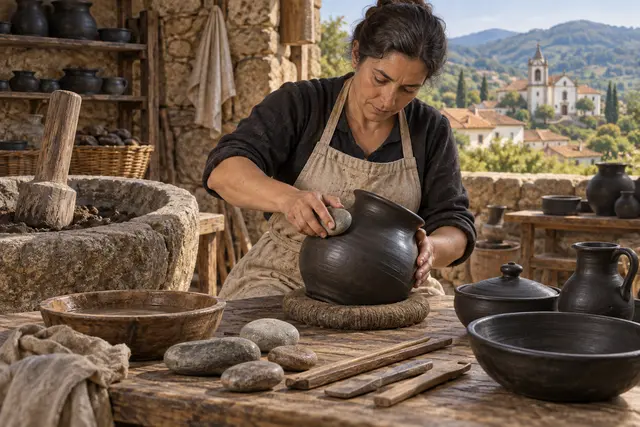
In Bisalhes, Portugal, black pottery belongs to a local know-how for both kitchen objects and decoration. Its manufacture begins with an energetic gesture: the clay is crushed with a wooden hammer in a stone container.
After sieving and adding water, the material is kneaded and then shaped. Wood tools are used to define the room, rollers to smooth the surface, and then a stick to trace the decor before cooking. Very simple objects thus intervene at several decisive stages.
The transmission is largely between close relatives, but the practice has also evolved: the clay can come from local tile factories rather than pits dug by potters. An ancient craft does not necessarily keep every detail unchanged. It is in particular the gestures learned and the way of chaining the work that make it possible to recognize this pottery.
What we know
Documented gestures; precise process giving the color not invented from an abbreviated notice.
To go to the source
References consulted on 3 October 2026. Linked pages may be in another language.
Signaler une erreur ou apporter une précision