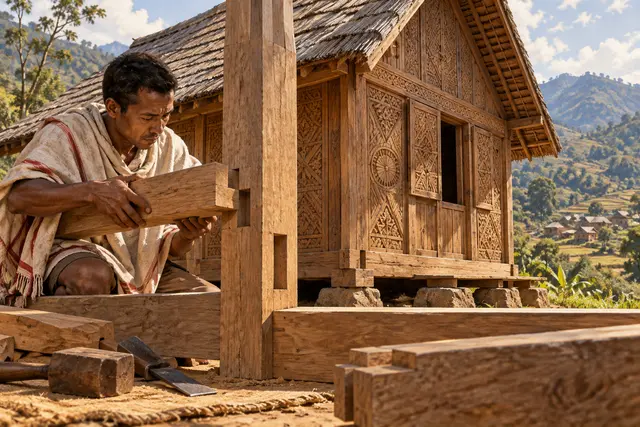
One nail is missing, then all the others: in traditional zafimaniry architecture, the rooms of the houses fit together in tenons and mortises. This community in the mountains of south-eastern Madagascar has a knowledge of wood that combines construction, choice of species and decoration. The precision of the assembly replaces the metal fasteners.
The carved surfaces add a second reading. Geometric motifs carry social meanings: the spider web can evoke family ties, the honeycomb the collective life. Doors, windows and everyday objects thus become mediums of expression. A shared repertoire does not prevent each craftsman from developing his own variations and his way of composing.
UNESCO recognized this body of knowledge in 2008, after a proclamation in 2003. Its notice also highlights deforestation and economic adaptations, including the sale of decorative objects. The work is therefore not limited to preserving old houses: it depends on available trees, transmitted gestures and the possibilities of living from his job.
What we know
Description of traditional architecture, without generalization in Madagascar.
To go to the source
References consulted on 3 October 2026. Linked pages may be in another language.
Signaler une erreur ou apporter une précision