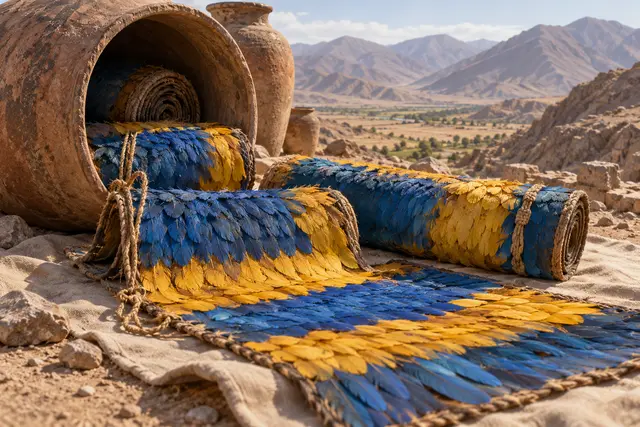
The colours might suggest a painting, but these panels are covered with feathers. Attributed to the Wari culture and dated between 600 and 900, they come from a group reported in 1943 in Peru’s Churunga Valley. The Metropolitan Museum estimates that the discovery included about ninety-six panels.
Rolled, placed in large jars and buried in arid terrain, they benefited from favorable conditions for their conservation. Many alternate blue and yellow areas obtained with aras feathers. These birds live in the rainforests east of the Andes, far from the dry land where the signs were found.
The contrast between the place of discovery and the origin of the feathers reveals movements of matter or birds. It does not say exactly how each trip was organized. Cords suggest a fixation on a structure, but the precise function of the panels remains uncertain. Their colors are bright; their old mode of presentation still retains a bit of shade.
What we know
Wari assignment; function and transport details unknown.
To go to the source
References consulted on September 21, 2026. Linked pages may be in another language.
Signaler une erreur ou apporter une précision