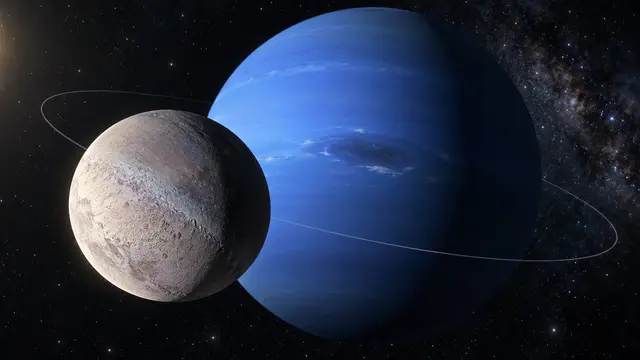
Neptune rotates on itself in one direction; its great moon Triton revolves around it in the other. This orbit, called retrograde, distinguishes Triton from the other large moons of the Solar System. The word “bad” does not describe any fault: it simply highlights a remarkable difference.
Such a configuration gives scientists a reason to think that Triton did not form near Neptune like an ordinary satellite. It may have been captured by the gravity of the planet after leading an independent existence among the small distant worlds. Its resemblance to Pluto reinforces the interest of this track.
The capture was obviously not observed by a probe. It is an original scenario, confronted with the current properties of the satellite. It is also necessary to separate its path around Neptune from its rotation on itself. This world does not tell us its past with archives: it perhaps keeps a trace of it in the very direction of its journey.
What we know
Proposed capture origin; retrograde orbit and clean rotation are two distinct movements.
To go to the source
References consulted on September 21, 2026. Linked pages may be in another language.
Signaler une erreur ou apporter une précision