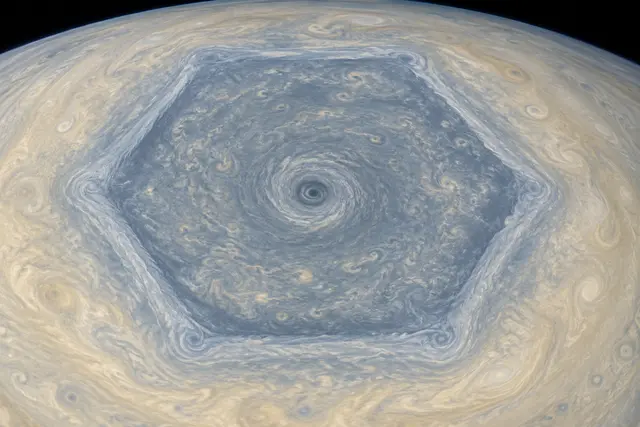
The Voyager probes had seen a baffling shape north of Saturn. Decades later, Cassini finds it again: a huge hexagon surrounds the pole. With its sides and angles, the pattern looks more like a geometric design than the messy weather we know.
This is an atmospheric current. Cassini made it possible to follow the clouds and the movements. When the pole was immersed in winter, its infrared instruments could still study it by detecting thermal radiation. The return of light then revealed more detail in the visible.
Experiments with rotating fluids also produce polygonal shapes: regular geometry does not require a constructor. This does not resolve all questions about the longevity of the Saturnian pattern. The surprise is precisely there: what appears to be a rigid boundary is made of moving air, and its shape has persisted between several generations of probes.
What we know
Natural atmospheric current; its form and persistence are not fully explained.
To go to the source
References consulted on September 21, 2026. Linked pages may be in another language.
Signaler une erreur ou apporter une précision