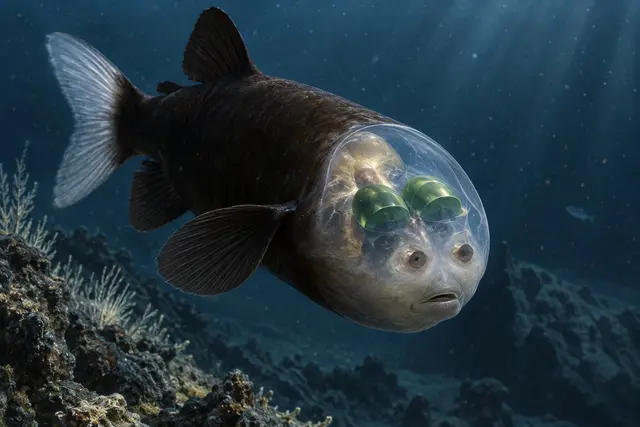
In an image of Macropinna microstoma, two spots above the mouth appear to form a familiar face. However, they are not his eyes: they are olfactory organs. The real eyes, green and tubular, are higher, under a transparent dome filled with liquid.
The old captured specimens had lost this fragile envelope. The observations of live animals made by the MBARI have therefore provided a detail that the catches in the net showed badly. The researchers also established that the eyes can change orientation, instead of remaining permanently pointed upwards.
The animal can thus look above it and then forward when it feeds. The transparency of the head does not give a naked brain to the eyes: it concerns a protection around the visual system. In this story, the mystery became clear when the researchers stopped looking at only the fish that had been brought back on board and observed what the net was doing.
What we know
Transparent dome of tissue, not completely invisible skull; mobility of eyes observed in live animals.
To go to the source
References consulted on 3 October 2026. Linked pages may be in another language.
Signaler une erreur ou apporter une précision