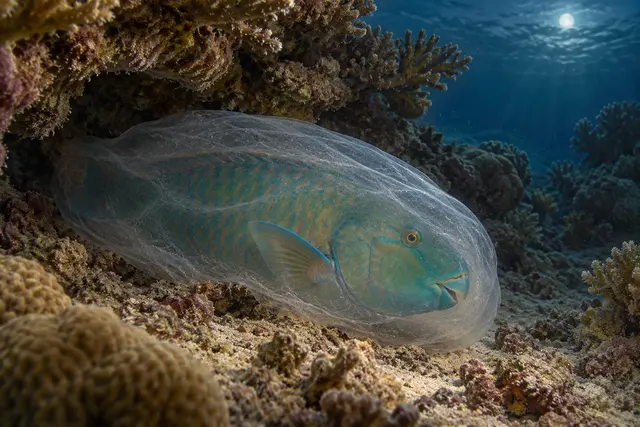
At nightfall, some parrotfish surround themselves with a mucus envelope. This cocoon does not prepare any metamorphosis: the fish remains a fish. The structure intrigues because it requires the production of matter. What is the advantage of making this protection before spending the night in the reef?
Researchers tested a lead at Chlorurus sordidus. They compared individuals who retained their cocoons with others whose envelopes had been removed, and then exposed them to small parasitic crustaceans, gnathiid isopods. Fish without cocoons suffered more attacks. In these experimental conditions, the envelope provided measurable protection against these nocturnal visitors.
Experience does not transform mucus into a universal shield. Nor does it prove that its main function would be to hide the smell of fish from large predators. The exact protection mechanism can involve several properties. But the result is enough to change our gaze: this strange nocturnal layer participates in a very concrete fight against parasites.
What we know
Experimental protection against certain parasites, without general invulnerability.
To go to the source
References consulted on September 21, 2026. Linked pages may be in another language.
Signaler une erreur ou apporter une précision