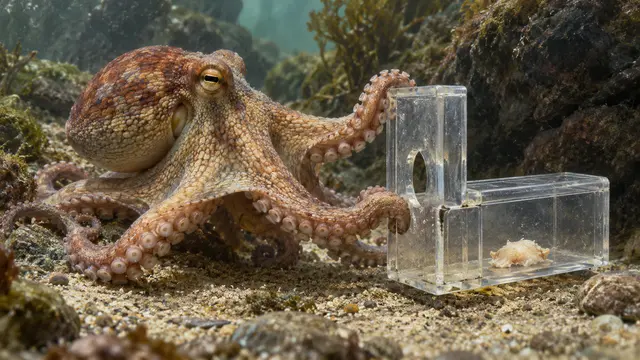
Pulling an object towards itself seems like a good way to recover what it contains. But if its shape prevents it from going through an opening, insisting is no longer enough. An experiment published in 2016 proposes precisely this kind of difficulty to octopuses.
The researchers use an L-shaped container and a breakthrough separation. The different steps require to open the container and then to pass it, adapting its orientation and the actions carried out. The seven animals studied pass both basic tasks, with differences in course and performance.
The result highlights a flexibility of behavior in the face of an unusual device. It does not allow to measure all the intelligence of a species, much less to align it with a human age. The little suspense of the laboratory is enough: when a traction fails, progress can start with the opposite gesture, release or push back to try otherwise.
What we know
Seven subjects, precise experimental tasks; no equivalence with a child’s intelligence is asserted.
To go to the source
References consulted on September 21, 2026. Linked pages may be in another language.
Signaler une erreur ou apporter une précision