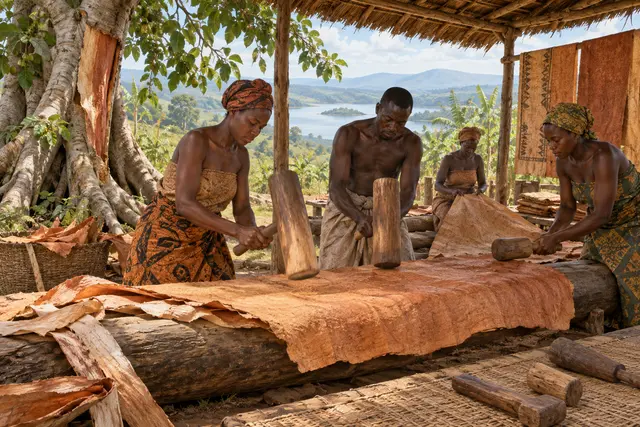
Before becoming clothing or hanging, this material looks like what it is: a part of a tree. In Buganda, southern Uganda, artisans harvest the inner bark of the mutuba, a fig tree named Ficus natalensis, during the wet season. The transformation then goes through no loom.
The work continues under an open shelter, so that the material does not dry too quickly. Different wooden mallets beat it for a long time, until it obtains a fine and supple surface, usually terracotta color. Knowledge resides in this succession of gestures, capable of converting a bark into a usable fabric.
The arrival of cotton in the 19th century reduced this production, without erasing its cultural functions among the Baganda. Ceremonial clothing, curtains or bedding show the diversity of documented uses. Transmission actions have also revived interest in the profession. This living heritage therefore does not describe the daily holding of all the inhabitants of Uganda.
What we know
Baganda know-how; uses vary according to context.
To go to the source
References consulted on 3 October 2026. Linked pages may be in another language.
Signaler une erreur ou apporter une précision