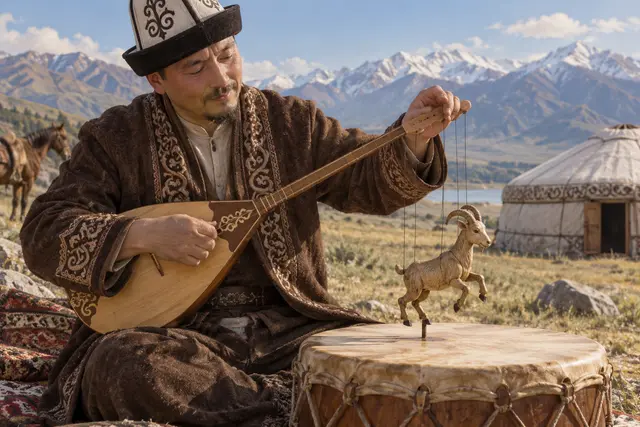
A small wooden mountain goat jumps to the rhythm of a dombyra, Kazakh instrument with two strings. One could look for the puppeteer behind the musician: in the orteke, they can be one and the same person. The fingers that play also control the movements of the animal.
The puppet is attached by a metal rod to the surface of a traditional drum and connected to the fingers of the musician by one or more wires. When he plays, the goat moves and hits the surface, adding its own pulsation to the music. Particularly skilled performers can animate at least three puppets simultaneously.
The know-how circulates in the communities and through learning, with also meetings between artists. It is not based on a mechanical animal that dances alone. The surprise comes from human coordination: a single sequence of gestures makes a melody sound and its little stage partner appear.
What we know
Puppet manipulated by wires; no mechanical autonomy or reconstituted particular scene.
To go to the source
References consulted on 3 October 2026. Linked pages may be in another language.
Signaler une erreur ou apporter une précision