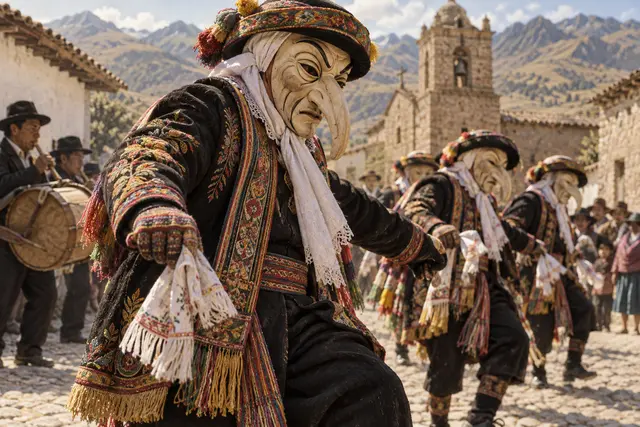
A long curved nose, a carved face and footsteps in the streets: in Mito, in the central Andes of Peru, the Huaconada occupies the first days of January. Masked dancers, called huacones, represent the ancient council of sages. Their appearance expresses ritual authority, rather than a mere entertainment character.
The nose of the mask evokes the beak of the condor in the symbolism described by the community. Dance distinguishes ancient and modern huacones, with different costumes and movement freedoms. The more experienced can improvise more, while an orchestra accompanies the figures and a small drum, the tinya, marks their rhythm.
The heritage candidacy emphasizes the expected conduct of the participants and the transmission of masks, clothing and gestures. It also describes a practice that incorporates new elements. The Huaconada belongs to this locality and its history: the authority of the characters is part of a ritual framework, continuously reinterpreted.
What we know
Ritual Authority; January 1 to January 3.
To go to the source
References consulted on 3 October 2026. Linked pages may be in another language.
Signaler une erreur ou apporter une précision