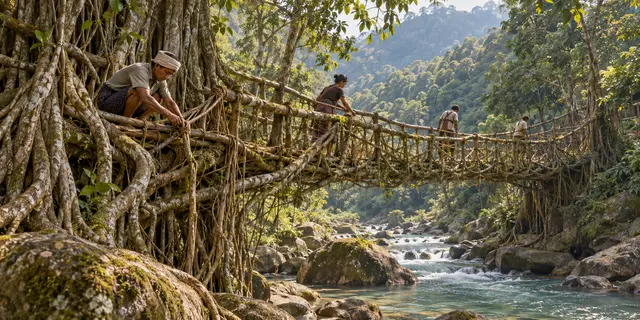
In Meghalaya, India, some bridges are not assembled solely with dead materials. Khasi and Jaintia communities direct the aerial roots of Ficus elastica over streams. The crossing takes shape as they grow, with human work continuing well after the first gestures.
The roots are guided, intertwined and then anchored on the other side. They can thicken and weld together, forming structures capable of carrying the passage. A field study published in 2019 describes their diversity: lengths, shapes, estimated ages and ways of maintaining the works vary by site.
It is not a bridge that the forest would have built alone. Builders intervene over several generations. Growth is part of the job site, but it does not replace their knowledge. These crossings invite us to look at a finished work differently: here, the material can continue to live and the maintenance continues to shape it.
What we know
Bridges require maintenance; their age is not always established by a certain date.
To go to the source
References consulted on September 21, 2026. Linked pages may be in another language.
Signaler une erreur ou apporter une précision