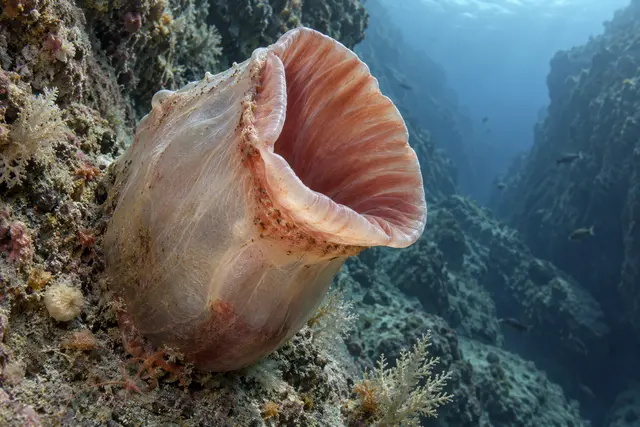
Fixed on the rocky bottom, Megalodicopia has a wide opening to the currents. This tunicate hardly looks like a mobile predator, but its mouth can close on prey. The movement changes the function of an organ which, in many of its cousins, serves mainly to bring in the water to be filtered.
Most tunicates collect small organisms in mucus and then discharge the water through another siphon. In Megalodicopia, the oral siphon forms large lips capable of swallowing invertebrates, especially crustaceans. This makes it possible to exploit larger meals in a food-poor environment.
MBARI robots have helped map its presence in Monterey Canyon, where individuals can be observed on rock walls. The animal does not become a passing monster: it remains attached to its support. Its originality consists precisely in capturing a meal without going in pursuit.
What we know
Animals of the genus Megalodicopia; no behavior attributed to all tunicates.
To go to the source
References consulted on 3 October 2026. Linked pages may be in another language.
Signaler une erreur ou apporter une précision