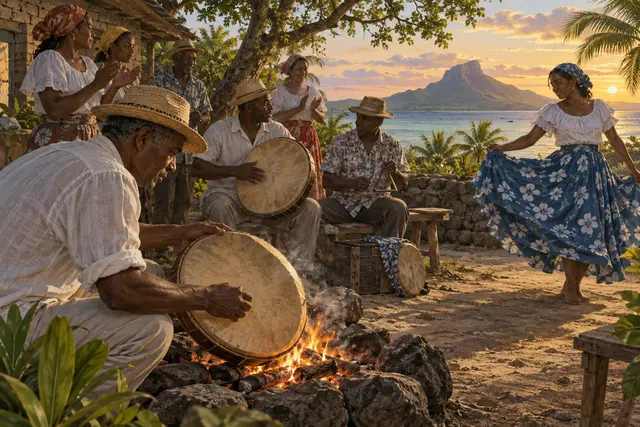
The music has not yet started, but the preparation is already part of the scene. In the Mauritian sega tipik, the ravine can be heated near a fire to tune it. The cultural inventory then describes a call from the drum that invites those present to gather around the musicians to start the performance.
The Mauritian Creole chant, the responses and the dance are based in particular on the ravanne, the maravanne and the triangle. Drum players can play different roles: one gives the tempo, others enrich the sounds. The ensemble is built between the people present, with improvisation, encouragement and changes in the energy of the dance.
The inventory clearly distinguishes organized performances, sometimes choreographed, from informal encounters between relatives. The stage costumes do not describe all the ways to practice this art. Inherited in particular from the descendants of people reduced to slavery, the sega tipik preserves a social history that goes beyond the only image of a show offered to visitors to the island.
What we know
Sega tipik is a particular style.
To go to the source
References consulted on September 21, 2026. Linked pages may be in another language.
Signaler une erreur ou apporter une précision