In 1732, Bologna celebrated Laura Bassi. At the age of twenty-one, she obtained a degree, scholarly distinctions and an academic position in natural philosophy. The event could look like a fully open door. Yet public recognition does not give him the same freedom to teach as his male colleagues.
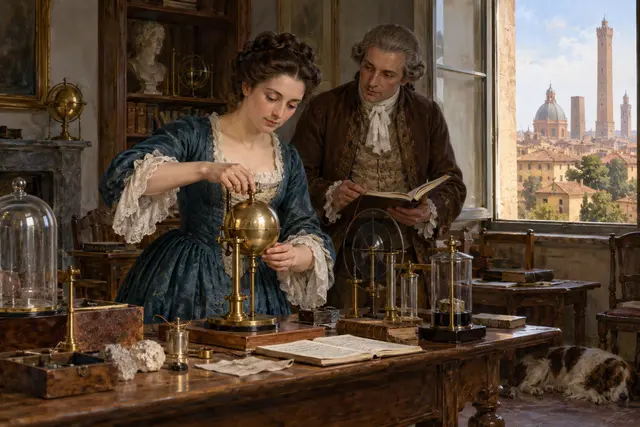
His public lessons are limited to special occasions. To continue her activities, she also works in her home with Giuseppe Veratti, her husband and scientific partner. From 1749, their laboratory became a place of teaching and research frequented by scholars. Experimental physics thus finds a place in a domestic space.
Bassi finally obtained in 1776 the post of professor of experimental physics at the Institute of Sciences. She died two years later. His journey requires looking behind the ceremonies: receiving a title and being able to fully exercise what it designates are two different things. The house had hosted an activity that the institutions were still limiting.
What we know
The appointment of 1732 did not remove the restrictions on teaching.
To go to the source
References consulted on September 21, 2026. Linked pages may be in another language.
Signaler une erreur ou apporter une précision