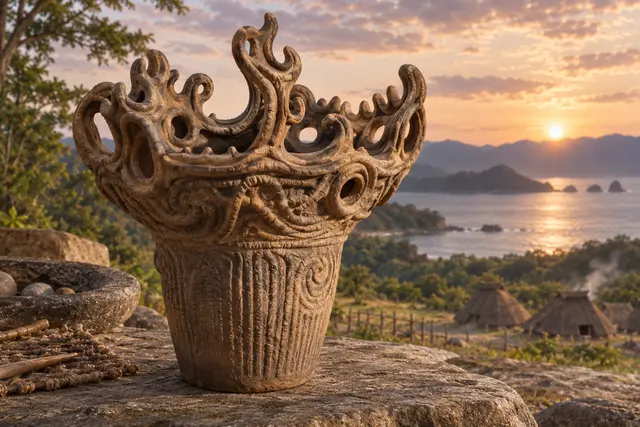
The edge of this vase does not just draw a circle. It rises in openwork reliefs, with curves that evoke flames. The Metropolitan Museum preserves this Japanese container from the middle Jmonmon period, dated approximately between 3500 and 2500 BCE. Its decor gives motion to a stationary material.
The body was mounted from doves, superimposed clay rollers, and then smoothed. Twisted ropes rolled over the surface have left their footprints. At the top, other doves form the complex handles. The construction and decoration thus appear as two parts of the same manual work, clearly visible in the result.
The modern term flame style describes a resemblance; it does not automatically convey the meaning that craftsmen gave to these forms. The Jmonmon pottery presents a great diversity. This vase simply invites you to look at an ancient object differently: several millennia before our museums, its creators had already made the edge a spectacle.
What we know
Descriptive flame style; unasserted symbolic intent.
To go to the source
References consulted on September 21, 2026. Linked pages may be in another language.
Signaler une erreur ou apporter une précision