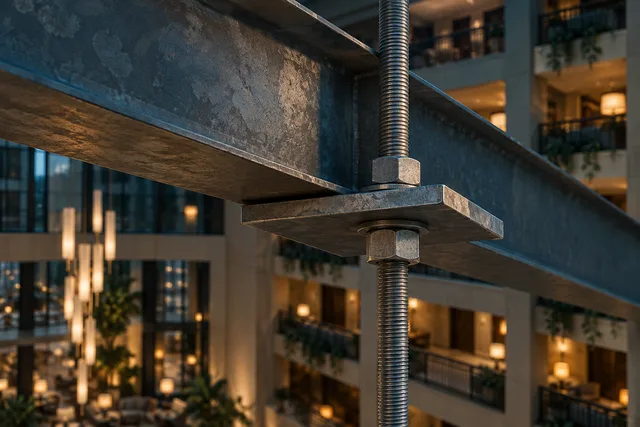
The lobby of the Hyatt Regency in Kansas City has walkways suspended above its central space. For visitors, they belong to the spectacular decor of a modern hotel. However, their safety is based on assemblies much less visible than the large volumes of the atrium.
On July 17, 1981, two of these bridges collapsed. The disaster caused many casualties among those present. Four days later, specialists from the National Bureau of Standards, now NIST, arrive to examine the debris and look for the mechanism of rupture.
The investigation identifies insufficient capacity in a connection between a beam and a suspension rod. The deformations observed in the recovered elements support the proposed location for the onset of collapse. It is therefore not enough to examine separately the resistance of a gangway or that of a rod.
The junction had to support the actual loads. The imposing appearance of the building said nothing of that discreet fixation on which the whole depended.
What we know
NIST identifies the critical connection; divergent human balance sheets are not mixed.
To go to the source
References accessed October 11, 2026. Linked pages may be in another language.
Signaler une erreur ou apporter une précision